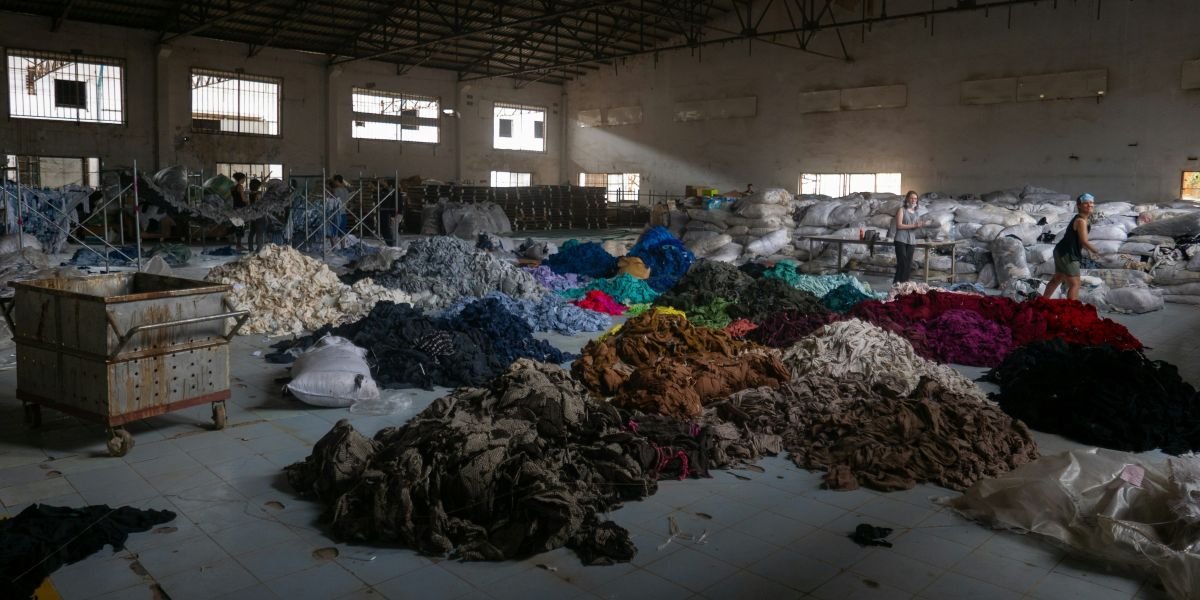

Sacramento lawmakers returning to the Capitol this week were met with an arresting sight: thousands of pounds of discarded clothing piled outside the seat of California government. The installation, organized by the New Standard Institute, was designed to visualize the scale of textile waste generated in California — and to press policymakers to treat fashion waste as a serious environmental issue rather than a niche concern.
The display, composed of approximately 4,500 pounds of clothing, represented what advocates say is only a fraction of what Californians discard every few minutes.
“Clothing waste is one of the fastest-growing waste streams in the world, and California is not immune,” the New Standard Institute said in a statement accompanying the installation. “This crisis is largely invisible — until you put it directly in front of lawmakers.”
A Growing Environmental Burden
According to CalRecycle, Californians dispose of more than 1 million tons of textiles every year, most of which ends up in landfills. Synthetic fabrics, which dominate modern apparel, can take decades or longer to decompose while releasing microplastics into soil and waterways.
The U.S. Environmental Protection Agency has similarly warned that textiles are among the least recycled consumer materials in the country. In its most recent waste characterization data, the EPA noted that less than 15% of discarded textiles are recycled nationwide, despite the material’s high reuse potential.
“Textiles are a significant component of municipal solid waste, and recovery rates remain low,” the EPA states in its waste management guidance.
Fast Fashion Under the Microscope
Environmental groups say the rise of fast fashion — driven by rapid production cycles, low prices, and online retail — has accelerated the problem. California, as both a major consumer market and a policy leader, is increasingly seen as a testing ground for reform.
The installation comes as state lawmakers consider proposals tied to extended producer responsibility (EPR), which would require apparel brands to help fund recycling, reuse, or waste-reduction programs.
Advocates argue that such measures mirror California’s leadership on plastic packaging and electronics recycling.
“California has shown before that smart regulation can reshape entire industries,” said a sustainability policy expert affiliated with the New Standard Institute. “Textiles are the next frontier.”
Economic and Climate Stakes
Beyond landfill capacity, textile waste carries significant climate implications. The Ellen MacArthur Foundation, a global authority on circular economy policy, estimates that the fashion industry accounts for up to 10% of global carbon emissions — more than international aviation and shipping combined.
“The current system for producing, using, and disposing of clothing is fundamentally broken,” the foundation has stated. “Without systemic change, environmental impacts will continue to accelerate.”
For California, which has committed to aggressive climate targets, the issue intersects with broader goals around emissions reduction, water conservation, and sustainable manufacturing.
A Visual Push for Policy Action
Organizers intentionally staged the installation at the Capitol to connect visual impact with legislative decision-making. By transforming abstract data into a physical presence, they aimed to shift textile waste from an overlooked issue to a tangible policy challenge.
Environmental advocates say the message is simple: consumer behavior alone cannot solve the problem.
“Recycling bins and donation drives are not enough,” the New Standard Institute said. “We need systems that hold producers accountable and give consumers better options.”
What Comes Next
As California continues debating environmental reforms tied to consumption and waste, the textile installation underscores a growing consensus: fashion is no longer just a cultural industry — it’s an environmental one.
Whether lawmakers respond with new legislation remains to be seen. But for a moment outside the Capitol, the scale of the problem was impossible to ignore.