

In the late 20th century, the interest in handmade furniture and craft woodworking grew alongside the broader design and domestic aesthetic movement across the United States. Artists and makers responded to, and explored the possibilities of, how to combine functional objects with artistic expression. Common to the approach toward fabrication was a strong focus on natural materials, organic forms, and the influence of the landscape upon design. In this instance, woodworking, for its inherent qualities of craftsmanship and function, enabled artists and designers to examine an intersection of technical skill, conceptual investigation, and practical purpose. Artists, who were interested in expanding their practice, became part of regional conversations in California and Texas, developing a community of exhibitions and marketplaces for peer and project-based experiences.
Jeff Robinson, having completed a formative period of his identity in ceramics, transitioned to woodworking in San Diego in the late 1980s. This transition occurred after his career in studio pottery, which he later discontinued due to an injury sustained while working at the potter’s wheel. Robinson moved into custom furniture design for friends and family, as he explored designs that created original furniture expressing shapes of natural pauses or curves. This design period also initiated a unique aesthetic characterized by fluid lines and curved shapes of the contours and patterns he observed while traveling. These designs were consistent in environmental scale and proportion, and an early exploration of spatial composition, structure, and balance.
During that period, Robinson’s furniture design methods involved careful selection and shaping of wood, building on his understanding of grain, texture, and color from his ceramics experience. He emphasized organic forms that affected functional use in addition to sculptural forms. The use of curves and flowing lines became a defining characteristic, offering a visual continuity between the surface treatment and structural elements of each piece. While the furniture was initially crafted for private use, it provided a foundation for understanding how individual components could be assembled into larger configurations, a concept that would later be applied to sculptural compositions.
Simultaneously with his creative practice, Robinson was involved professionally in the flooring industry, where he contributed to the formation and growth of Solar Contract Carpet in multiple states. His work involved operations management, growth, and development of the business, creating a multi-state organization. The combination of this type of professional business responsibility and the immediacy of experimenting with furniture evolution in woodworking meant that practical time-management solutions would be required and that a continued emphasis on design development would be necessary.
This is an example of how an artist can balance creative practice and entrepreneurial practices, attraction of their product, and both artistic sustainability and financial viability.
Furniture by Robinson during this period has been interpreted as having a technical rigor of execution and aesthetic consideration in every detail of proportion as it related to their function and ability to engage the observer visually. Each design integrated features that were inspired by the observed natural landscape, fluid curves and undulating forms are evidence of the artist’s engagement with elemental observation of the environment and ability to feel balance when composing signature artwork, by achieving posed form and structure of the furniture design, transitional candidly into sculpture and the articulation of how to approach drawing together patterns associated to an assembly of details within complex multiple assemblied structures, moving forward in separate exploration.
Thus, this period is a significant milestone in Robinson’s professional development and eventual work.
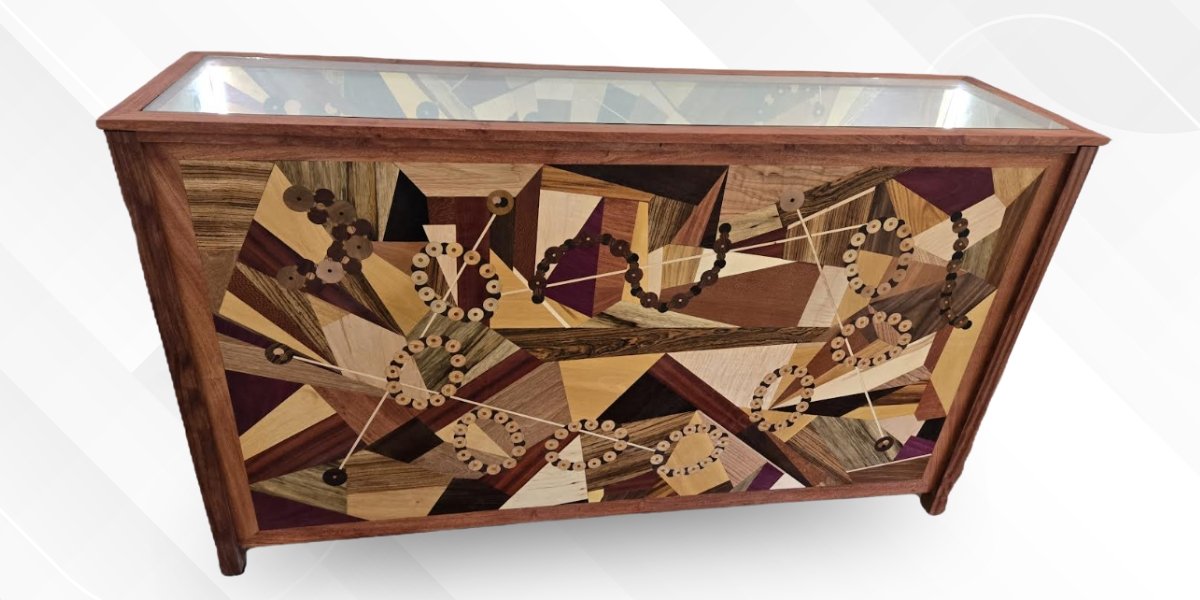
By the early 2000s, Robinson’s work in furniture had evolved to include pieces that combined modular construction with expansive visual patterns. While continuing to refine his furniture designs, he maintained an interest in formal experimentation and material properties. The experience gained in furniture design influenced later sculptural practices, particularly in terms of the organization of multiple components into cohesive forms and the manipulation of three-dimensional space. The principles of balance, proportion, and visual flow observed in his furniture work became central considerations in subsequent sculptural output.
Robinson’s engagement with both the artistic and business dimensions of his career demonstrates a dual professional orientation that integrates creative practice with operational management. Robinson’s contributions to the flooring sector offered economical integrity and integrity for larger teams, which provided guidance to organizational frameworks used in studio practice. The synergetic blend of technique, design sensibility, and practical operational expertise highlights how mid-career transitions can lead to the evolution of artists’ practices and indicate new career opportunities.
The process of Robinson’s revising of his aesthetic during this time presents a more general pattern for artists working across media who carry principles from one discipline into innovation in another. The focus on natural form, proportional relationships, and visual continuity in his furniture design draws on an understanding of compositional dynamics that can transcend both material and function. These elements became integral to later work in sculpture, where the assembly of multiple wooden elements into larger forms required both design precision and conceptual coherence.
From the latter part of the 1980s to and including his move to Dallas in 2010, Robinson’s work in woodworking and furniture design constituted a large segment of his professional trajectory. The practice of creative experimentation within an aesthetic-driven, hands-on construction and business-oriented framework laid a foundation for Robinson’s subsequent sculptural practice. Blending ideas from the lessons of ceramics into furniture design and professional practices, Robinson developed a pedagogical approach to sculpture that he drew from throughout his career, emphasizing balance of structure, flow of visual information, and material integrity. Therefore, this is an essential foundational stage in understanding the larger-scale wood sculpture produced in later stages of his long career.
Jeff Robinson’s move from ceramics into woodworking and furniture design highlights the ongoing professional path of an artist balancing creative exploration with entrepreneurial engagement. The works produced in San Diego, alongside those in other locations, served as the basis for further explorations of the formal assembly of sculpture, engaging multiple techniques and practical learning in materials and form. Synthesizing technical skill with design concepts and practical business logic, Robinson established scaffolding for his professional creative practice, which would serve as the scaffolding for Robinson’s pluralism of contemporary sculpture.