

By: Elena Mart
A Silicon Valley student’s innovative approach bridges continents with code, aiming to close a deadly diagnostic gap.
SAN JOSE, CA – While many high school students focus on local community projects, Luxi (Lucia) He, a student at San Jose’s Valley Christian School, has set her sights on a global health crisis.
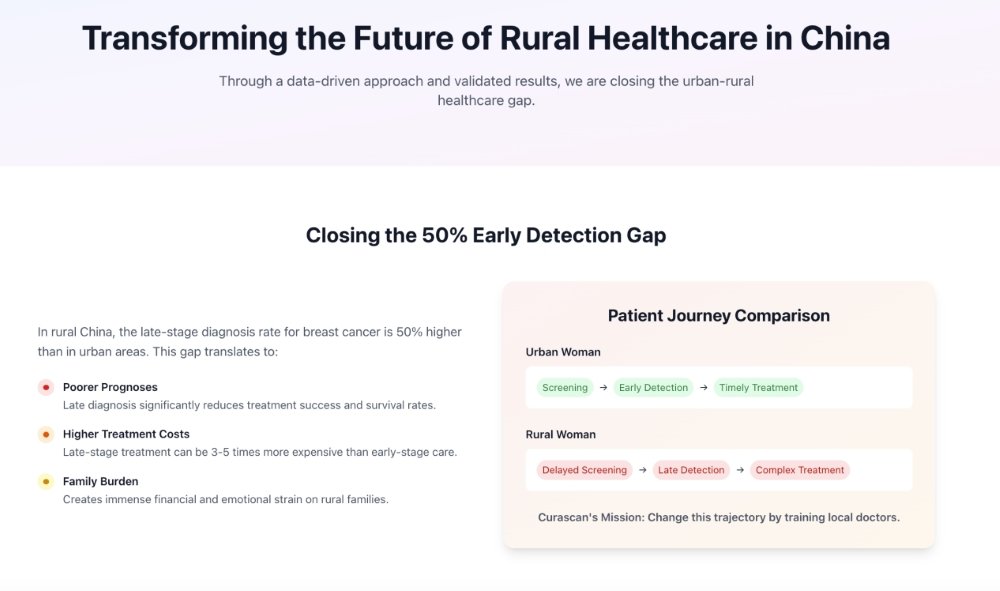
She has developed Curascan, a sophisticated AI-powered training platform designed to empower doctors in rural China, where the risk of late-stage breast cancer diagnosis is 50% higher than in urban centers.The project is a direct response to a stark disparity: China’s rural regions, home to nearly half a billion people, have a physician-to-population ratio just one-third of their urban counterparts. This scarcity of specialists means limited access to quality training, making early, life-saving cancer detection a matter of geography.
“This isn’t just a resource gap; it’s an equity gap,” explains Lucia. “The technology exists to change this, but the challenge is designing a solution that understands and respects the complex reality on the ground. We wanted to build something that doesn’t just impose a technical fix but integrates seamlessly into the social and professional fabric of these communities.”
Curascan is far more than a simple mobile app. Lucia describes it as a meticulously designed “sociotechnical system,” a concept often discussed in university-level engineering courses, where technology and social context are jointly optimized. The platform’s innovation rests on three pillars that showcase a level of design thinking rarely seen outside of professional tech startups:
1. Pedagogy as Code:
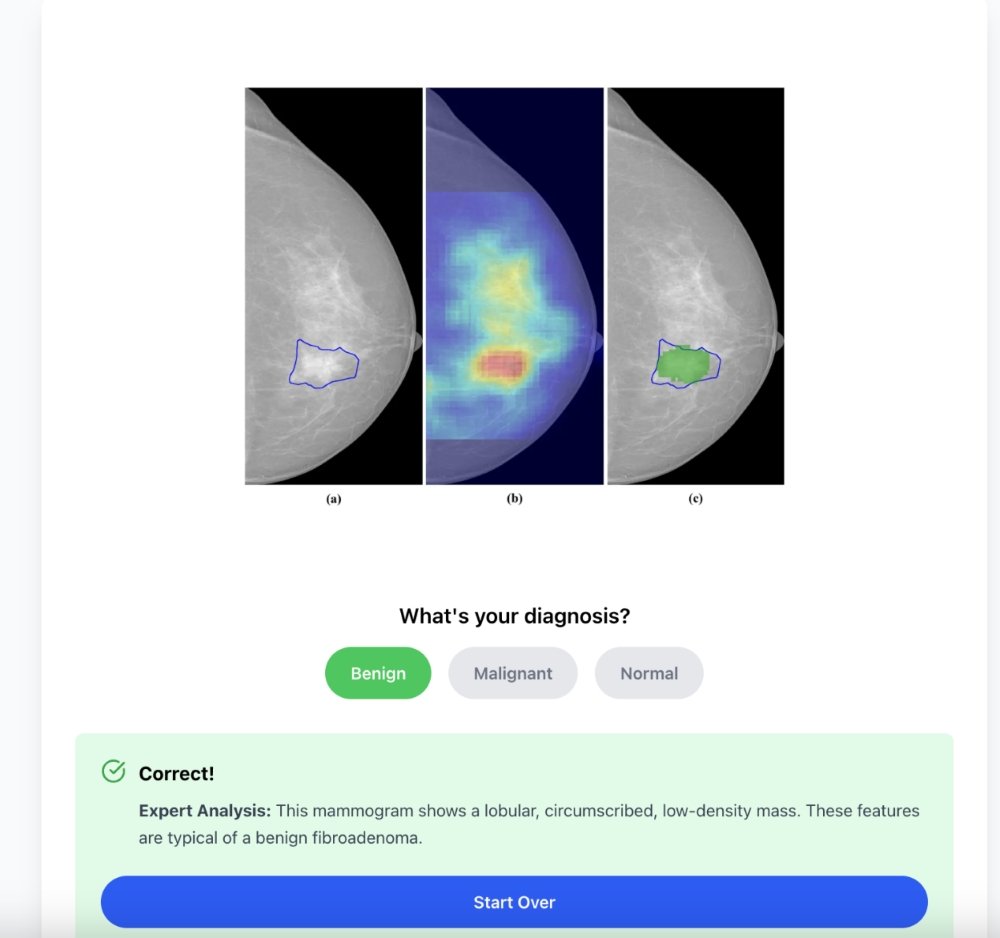
Instead of being a simple image gallery, Curascan’s architecture hard-codes a sophisticated clinical learning process. Each case in its vast library requires rich contextual data—patient history, differential diagnoses, key teaching points—forcing a holistic, reasoning-based approach to diagnostics, not just visual pattern matching.
2. A Dual-Engine AI:
The platform uses two distinct AI systems working in synergy. A Content Engine employs generative AI to create a vast, diverse library of over 20,000 mammography cases, including hyper-realistic simulations of rare pathologies that a rural doctor might otherwise never encounter. A Pedagogy Engine then acts as a personalized tutor, using machine learning to analyze a user’s performance, identify specific weak spots (like difficulty with “architectural distortion” cases), and dynamically tailor the curriculum to address them.
3. Frugal Innovation Through Ecosystem Design:
In a strategic masterstroke of “frugal innovation,” Curascan is built as a WeChat Mini-Program. This decision bypasses the friction of app stores and leverages an ecosystem already central to professional life for Chinese physicians. It drastically cuts development costs, lowers adoption barriers, and allows the platform to spread organically through trusted peer networks—a brilliant fusion of technical design and deep cultural insight.
The results are tangible. Trials have shown that medical professionals using Curascan improve their diagnostic accuracy by a remarkable amount.
Lucia’s project operates as a social enterprise, using a low-cost subscription model to ensure its long-term sustainability and continuous improvement—a stark contrast to grant-funded projects that can vanish when funding dries up. It represents a new paradigm for “digital task-shifting,” empowering general practitioners with specialist-level skills and fundamentally strengthening primary care from the ground up.
“Curascan is born from the spirit of Silicon Valley—the belief that bold, intelligent technology can solve hard problems,” says Lucia. “But it’s a vision applied with empathy, focused on creating a sustainable, accessible, and truly impactful tool for those who need it most.”
About the Innovator
Luxi (Lucia) He is a student at Valley Christian School in San Jose, California. Her work on Curascan merges a passion for cutting-edge technology with a profound commitment to global health equity, embodying the next generation of innovators who are building bridges not just with technology, but with empathy and deep sociotechnical understanding.
Contact:
Luxi (Lucia) He
Disclaimer: The information presented in this article is for general informational purposes only. The effectiveness of the AI platform, Curascan, and its impact on diagnostic accuracy may vary. The views and opinions expressed are those of the author and the innovator, and do not constitute medical or professional advice. For specific medical concerns or inquiries, please consult a healthcare professional.