
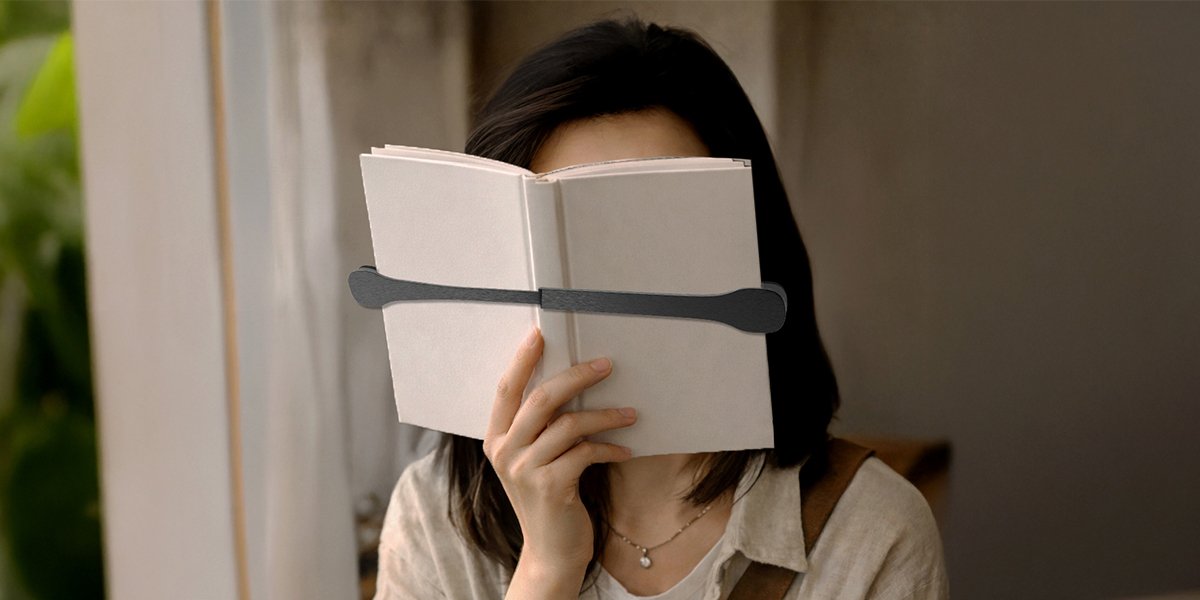
One of the most personal experiences we all have daily is reading. Whether we’re reading in a cozy spot, on our way to work, or right before bed, reading is an experience that allows us to focus on our thoughts. However, the physicality of reading is something that we don’t even realize we’re doing. The way we hold a book open, with our hands positioned to read, is something we don’t even realize is tiring our hands. However, with Booky, industrial designer Hsintzu (Cindy) Chang has created an object that makes reading a little easier for people. The object itself is a small reading tool that helps to keep the book open for the reader. However, it also helps to alleviate the strain that is put on the reader’s hands. The object is able to do this by clipping onto the two sides of a book. This allows the reader to read without holding the book open. What’s more, the object is also designed so that it can be used as a bookmark.
As an industrial designer who focuses on furniture, home items, and tools, Hsintzu (Cindy) Chang has created a design that emphasizes how people interact with the object. Her work examines how small design interventions can shape daily habits and improve comfort without disrupting familiar routines. The object is discreet and does not interfere with the reading experience.
Observing the Small Frictions of Reading
The idea behind Booky came out of a simple observation. When people read a physical copy of a book, they usually use one of their hands to flatten the pages. This repetitive practice can cause strain on the hands and fingers. Though the strain may not be significant at the beginning, it usually becomes more apparent over time spent reading the books.
For some readers, the strain may be more significant. Temporary fatigue or conditions such as arthritis, carpal tunnel syndrome, or hand weakness can make it difficult to hold books. Chang approached the problem as an inclusive design challenge: how to reduce strain while preserving the natural pleasure of reading.
Designing for Comfort and Simplicity
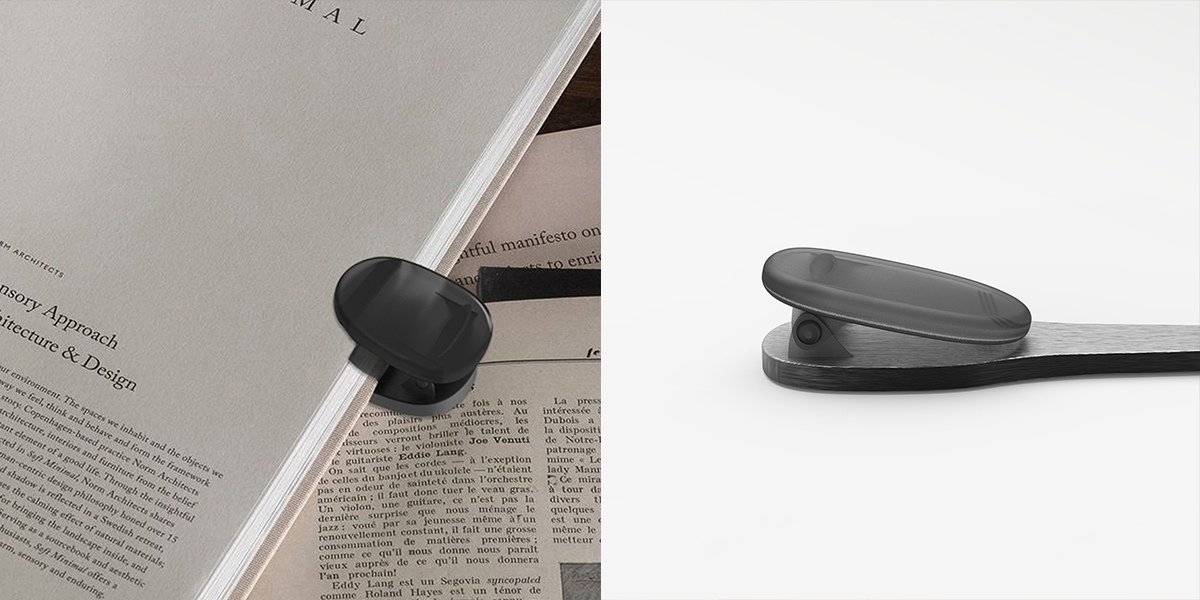
Booky is an adjustable reading tool that clips on the edges of a book to hold the pages open. The tool has an anti-slip surface that gently holds the pages without damaging the paper. This allows the reader to flip the pages with ease while keeping their hands relaxed. The tool is adjustable to accommodate various book sizes. The width ranges from 250 to 400 mm. This allows it to support various book sizes from small paperbacks to larger hardcovers. The tool is also lightweight due to its slim profile of 20 mm. This allows it to be portable. The design is straightforward. The tool is attached to the two sides of the book to hold the pages. After reading, the tool is clipped to the top edge of the book to act as a bookmark. This is a two-in-one tool that aligns with Chang’s goal of designing objects that perform two functions without added complexity.
Balancing Ergonomics and Everyday Aesthetics
One of the major issues that Booky had to address was creating an ergonomic product that would be both natural and unobtrusive. Reading is a very intimate experience, and any product that is designed to be used during this time needs to be able to integrate seamlessly into that process. Chang’s study focused on reducing grip force without sacrificing stability. The product incorporates anti-slip material that reduces the grip force required to keep a book open. At the same time, it is designed in a way that is not recognizable as a medical aid but instead appears to be a simple, accessible product that can be used by a wide cross-section of society.
From Concept to Production
Booky is designed to be easily manufactured, using injection molding or 3D printing. The product is also mechanically simple, enabling manufacturing that is both robust and lightweight.
Designing for Everyday Moments
For Chang, industrial design is not about creating large-scale objects or dramatic innovations. Sometimes, the most important breakthroughs are the ones you find in the tiniest details of our lives. A well-designed object can actually ease our lives so we can concentrate on what is most important, like the joy of reading.
With Booky, Chang demonstrates how design can solve one of the most common but least considered problems. By cradling a book open and easing the strain on our hands, Booky lets readers enjoy their books even more.
Booky is not just a reading device; it values empathy, observation, and the belief that even the smallest tools can enrich everyday experiences.