
By: Shawn Mars
The market does not always reward the most talented, the hardest working, or even the most experienced. It tends to reward the people and brands whose authority is most clearly positioned. That idea sits at the center of how Serah D’Laine approaches her work, and it explains why she believes the businesses that win attention in the years ahead will not be the ones that simply produce the most content.
For D’Laine, the founder of STAGE•IIX, the real obstacle most professionals face is not a shortage of capability. It is a gap in positioning. Two people can hold the same skill and the same track record, yet one becomes the keynote speaker, the trusted advisor, the name invited into rooms others never enter. The difference, she argues, is how clearly the market understands their value.
“Authority is the bridge between excellence and opportunity,” is how she frames it. Talent opens a door. Recognition decides who walks through it.
Reputation Has Become Searchable
Twenty years ago, a professional reputation lived mostly in rooms. It moved through introductions, referrals, and word of mouth. Today, it lives in search results, articles, podcasts, videos, social profiles, knowledge panels, and the AI summaries that increasingly sit between a person and the information they are looking for.
That shift changes what a reputation actually is. It is no longer confined to a résumé or a portfolio. It has become a digital asset, formed long before the first conversation ever takes place. By the time a prospective client, partner, or audience member reaches out, they have usually already formed an impression from the signals a person leaves behind.
D’Laine’s view is that this makes authority too important to leave to chance. If reputation is now assembled from searchable fragments, then those fragments deserve to be shaped with intention rather than assembled at random.
The Limits of the Visibility Economy
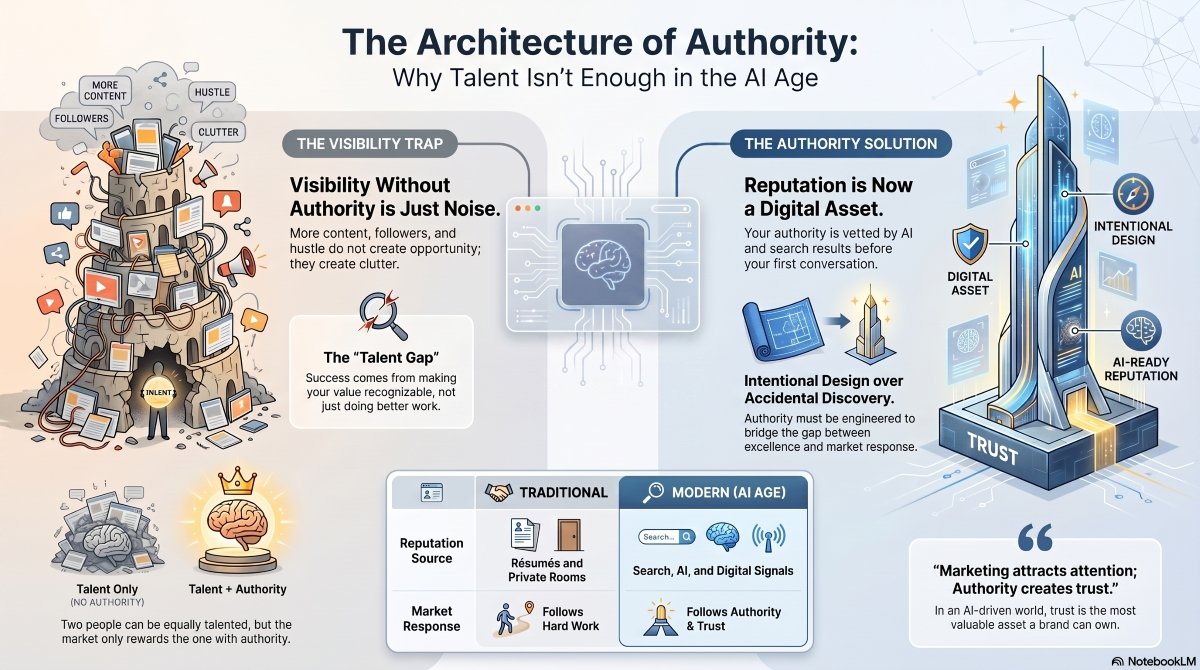
Much of modern marketing rests on a simple promise. More content, more followers, more posting, and more hustle are supposed to create more opportunities. D’Laine challenges that assumption directly. In her experience, visibility on its own does not build trust. It often just adds to the noise.
She made the point in a recent article from CEO Weekly, where she put it plainly. “Everyone can be seen now, but visibility without positioning just creates more noise. Visibility with credibility creates authority,” she said.
The distinction matters because attention is easy to manufacture and hard to convert. A brand can reach large audiences and still struggle to be remembered or trusted. What, in her view, separates the brands that quietly move ahead is not volume. It is clarity about who they are and why they deserve attention.
From Hollywood to the Psychology of Trust
Before D’Laine moved into consulting, she spent more than a decade working in Hollywood as an actress and producer, appearing in feature films and television series. That period shaped how she understands audience psychology, perception, storytelling, and public image. Performance taught her that audiences respond less to perfection and more to authenticity and presence, often without consciously realizing why.
Those lessons became the foundation of her later work with business leaders. Rather than treating branding, psychology, public relations, and AI strategy as separate disciplines, she draws them into one framework. The organizing question behind all of it is consistent. Why do certain people and brands become trusted, remembered, and highly valued while others, with similar ability, remain overlooked?
Over the past decade, D’Laine has studied how audiences assign value, how leaders make decisions, and how markets create meaning. More recently, she has focused on how artificial intelligence evaluates credibility, since the systems that summarize and recommend are now part of how reputation forms.
Designing Authority on Purpose
Through STAGE•IIX, D’Laine works with founders, executives, luxury brands, and established experts who often share a common problem. Their business has evolved, but the way the market perceives them has not kept pace. The offline experience may be excellent, while the digital presence tells an older or thinner story.
Her response is to treat positioning as a structured process rather than a creative afterthought. That means clarifying what a brand stands for before deciding how often to post, and understanding perception before chasing tactics. The goal is to close the distance between real accomplishment and the way an audience interprets it.
“We believe the future belongs to leaders and brands whose authority is intentionally designed, not accidentally discovered,” D’Laine says. It is a fitting summary of how she sees her own role. She describes the work less as branding and more as helping the market assign value accurately to people and companies that have already earned it.
As the digital economy continues to fill with content and automation, that clarity is likely to matter more, not less. Opportunity, in her reading of the market, does not simply follow talent. It follows trust, and trust follows authority.
To learn more about Serah D’Laine and her work, visit her personal website or follow her on Instagram.