

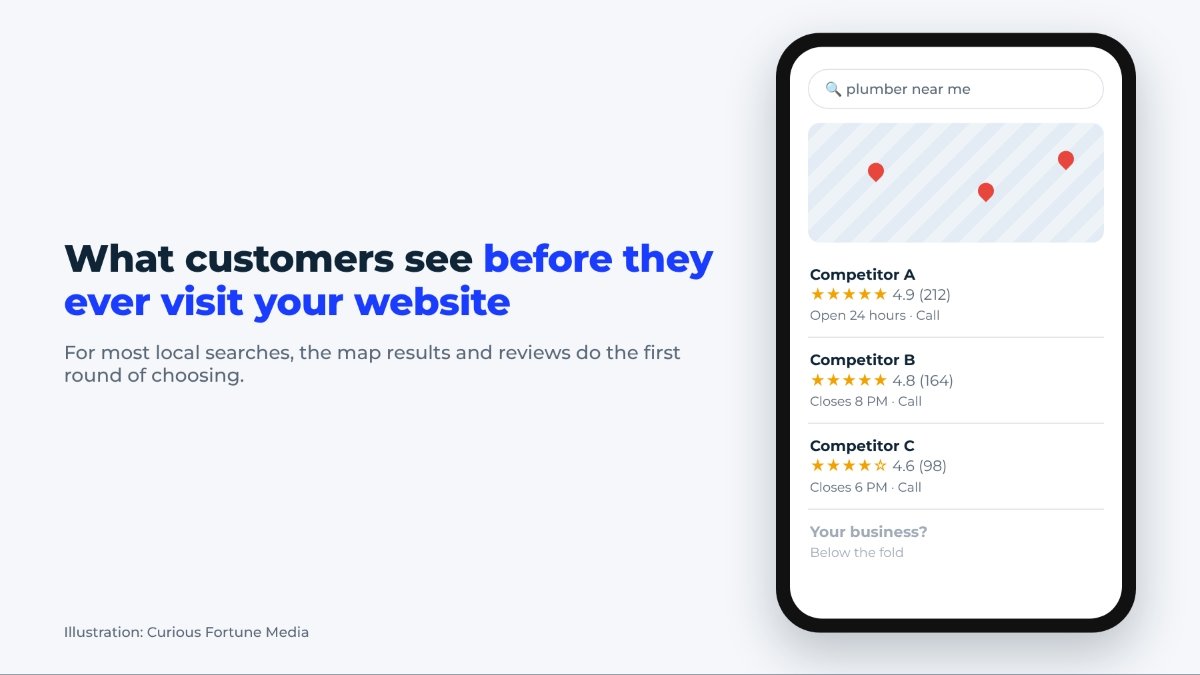
A search for an emergency plumber in a California neighborhood can turn up a surprising set of map results. A small, locally owned operation sometimes ranks above a regional or national brand that spends far more on advertising, even when the larger company’s ads sit at the top of the page.
That gap reflects how local SEO for small businesses actually works. Budget can buy sponsored listings, but the unpaid local results tend to reward relevance, proximity, and proof. California has 4.3 million small businesses, 99.8% of all businesses in the state, according to the SBA Office of Advocacy’s 2025 California small business profile. For California service businesses competing against larger brands, that distinction leaves an opening many owners don’t use.
Key Takeaways
- Google ranks local results based on relevance, distance, and prominence, and says you can’t buy a better local ranking.
- Larger competitors often spread their attention thin across many locations.
- Focused service pages, a complete Google Business Profile, and steady reviews can give California service businesses an edge.
- Dense markets like Culver City tend to reward specificity over scale.
- This approach takes months and has clear limits.
Local SEO for Small Businesses Rewards Relevance, Not Budget Size
Google’s guidance on local ranking says results depend mainly on three factors: relevance, how well a listing matches the search; distance, how far the business is from the person searching; and prominence, how well known the business is, based on reviews and links from other websites. The same guidance says you can’t request or pay for a better local ranking.
That separates two kinds of visibility. A statewide advertising budget can secure sponsored placement above the results. It cannot buy a spot in Google’s unpaid map results, where a nearby specialist with a clear, well-reviewed listing can outrank a distant chain for a neighborhood search.
Where Smaller Operators Find an Edge
Multi-location brands often run large sets of templated location pages that differ only by city name and address. A smaller operator can go deeper on the few areas it actually serves, with service pages that describe specific work, local conditions, and the questions customers there tend to ask.
The other pieces are familiar but often neglected: a complete Google Business Profile with accurate categories, hours, and service areas; a steady flow of genuine online reviews; and mentions in local press, neighborhood associations, and community organizations, which can add to the prominence Google describes.
“Small businesses usually lose when they try to look big everywhere,” said Edmond Abramyan, founder of Curious Fortune Media. “They win when they’re obviously the right answer in one place. That comes down to focus and proof, not how much they spend.”
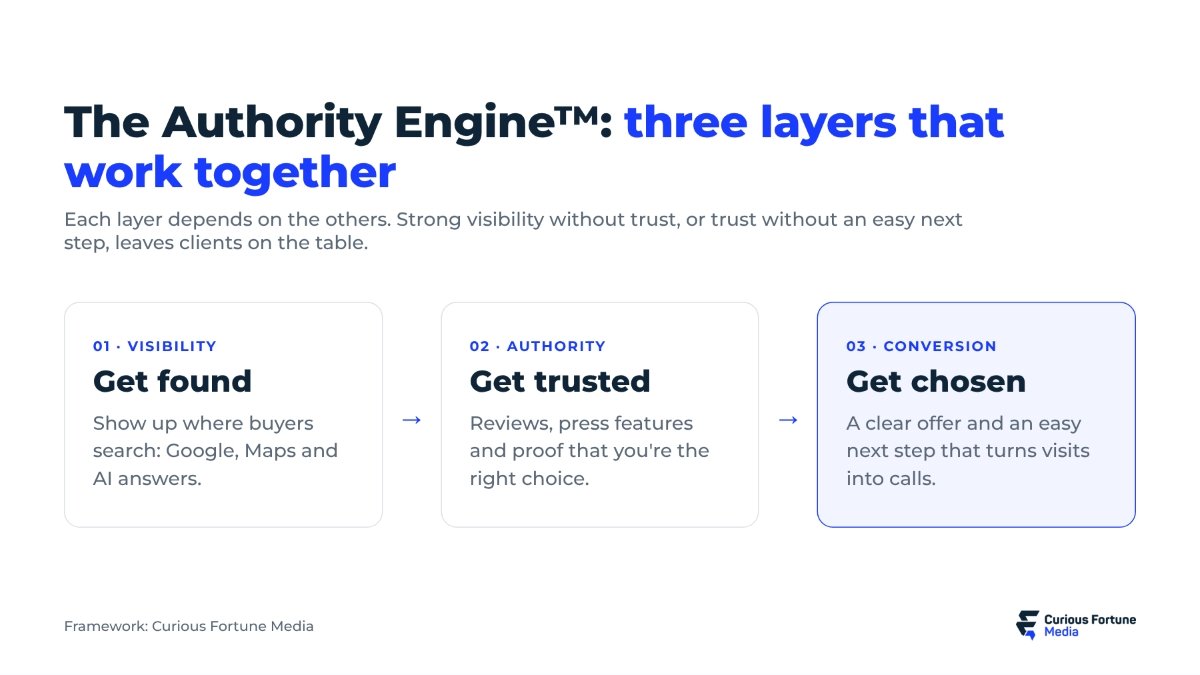
Those elements pay off only when they reinforce each other, with the listing, local pages, and reviews all describing the same business in the same market. Abramyan built the Authority Engine™ at Curious Fortune Media to work one market at a time, in this order: visibility so the business shows up for nearby searches, authority so reviews and local mentions back it up, and conversion so the searcher actually calls.
The principle holds beyond local search. During Abramyan’s work with Vintage Modern, a luxury maker of fully modernized classic vehicles with modern safety features, the company’s site outranked Ford Motor Company on several keywords. A specialist with a fraction of Ford’s budget won those searches on focus and relevance.
Dense Markets Like Culver City Show the Pattern
Dense markets make the dynamic easy to see. Culver City, a separate city on L.A.’s Westside, fits restaurants, creative firms, wellness studios, professional offices, and home-service providers into a few square miles, from Downtown Culver City to the Hayden Tract and the Washington Boulevard corridor.
Neighborhood-specific searches there often favor businesses with clear local relevance over larger brands with more general pages. Culver City is also one of the Westside markets where the agency Abramyan founded works with local service businesses.
“In a market this tight, nobody is choosing between a local shop and a national brand in the abstract,” Abramyan said. “They’re comparing whichever businesses show up for their street. The one that clearly says what it does, has reviews from last month, and obviously belongs to the neighborhood usually gets the call.”
Focus Has Limits
The approach has boundaries. Broad statewide or category searches still tend to favor large brands, national directories, and publishers. Proximity also can’t be manufactured. Google’s guidelines for representing a business require a Google Business Profile tied to a real-world location, and P.O. boxes and virtual offices aren’t eligible. Results shift over time, AI-generated answers can vary from one search to the next, and progress typically takes months, with no guarantee of any position.
Within those limits, focusing on one market can often outperform a broad budget because Google’s local results weigh relevance, distance, and prominence rather than spend. California service businesses may get more from deepening their presence in the markets they actually serve than from trying to match a competitor’s statewide reach. As AI-generated answers increasingly summarize local options, the businesses that get named may be those whose local credibility is clearest and easiest to verify, not those with the biggest budgets.
FAQs
Can a small business outrank a national chain in Google’s map results?
Often, yes, for searches tied to a specific area. Because Google weighs relevance, distance, and prominence, a nearby business with a strong local presence can rank above a larger brand.
Can a business pay Google for a better local ranking?
No. Google says you can’t request or pay for a better local ranking, though businesses can buy sponsored ads that appear separately.
How long does local SEO take to show results for small businesses?
It varies by market and trade, but meaningful progress typically takes several months, and no one can guarantee a position.