
By: Mason Caldwell
Country music may have its commercial headquarters in Nashville, but some of its most important rebellions have always come from the West.
California proved that decades ago. Bakersfield musicians took the polished Nashville Sound and roughed up the edges, creating a harder, twangier alternative driven by electric guitars, steel, fiddle, and working-class experience. Buck Owens and Merle Haggard became its most famous ambassadors, but the larger California country tradition has always been about something deeper: independence.
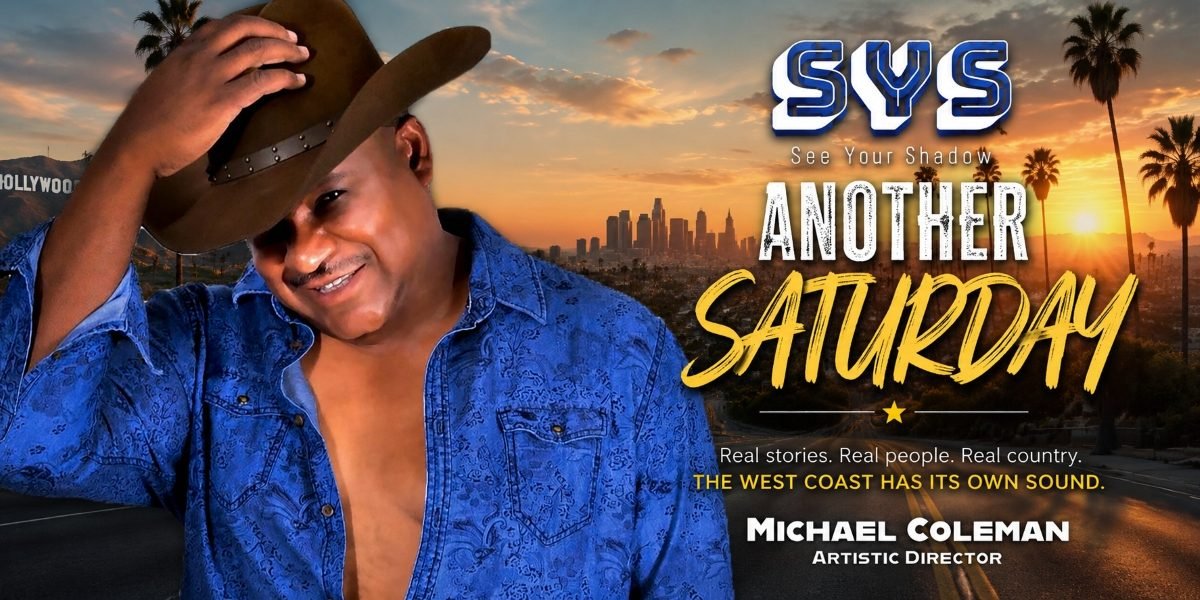
That independent streak makes an interesting backdrop for See Your Shadow and its latest single, “Another Saturday”.
Based just across California’s eastern border in Phoenix, Arizona, See Your Shadow is the creation of songwriter, producer, and Artistic Director Michael Coleman, an artist who has similarly chosen to build his career outside the conventional Nashville machinery. Rather than functioning as a traditional band, See Your Shadow operates through what Coleman calls his “Network of Stars,” assembling different musicians and vocalists to bring his compositions to life.
It is an unconventional approach that has produced remarkably conventional evidence of success: awards, recognition, and a run of eight consecutive chart-topping singles.
Yet statistics tell only part of the story.
Coleman’s greatest strength is his fascination with people, particularly the complicated people country music sometimes overlooks while chasing bigger choruses and easier answers.
“Another Saturday” is a perfect example.
The song introduces a woman waking in a haze beside a stranger. Whatever excitement existed the previous night is already gone. She sends him away, steps into the shower, confronts herself in the mirror, and begins preparing to repeat a cycle she seemingly understands but cannot yet escape.
Coleman could have written the character as a warning.
Instead, he writes her as a human being.
That distinction gives “Another Saturday” its emotional weight.
The song’s pivotal observation is devastatingly simple: she is no longer anybody’s girl, even though she once was somebody’s wife. Beneath the romantic wreckage lies the real subject of the song: identity. What happens when the person you thought you were disappears along with the relationship that helped define you?
It is the kind of question that feels surprisingly at home in the California country tradition.
California has always complicated the mythology of country music. The state gave the genre migrant workers, honky-tonks, Hollywood dreamers, country-rock experimenters, and musicians who refused to accept that Nashville should dictate what country was supposed to sound like. The Bakersfield Sound itself emerged partly as a reaction against Nashville polish, favoring something rawer and more direct.
Los Angeles developed its own country ecosystem as well. The legendary Palomino in North Hollywood became one of the West Coast’s defining country venues, hosting everyone from Johnny Cash and Patsy Cline to Buck Owens, Merle Haggard, Linda Ronstadt and Emmylou Harris while eventually opening its doors to country-rock, cowpunk and artists who blurred genre boundaries altogether.
Coleman shares some of that boundary-resistant spirit.
See Your Shadow may be known for country material, but Coleman has never viewed the project as confined to one musical box. The song determines the presentation, not the other way around.
And “Another Saturday” proves why that philosophy matters.
Strip away its country arrangement and the story survives. It could become a blues number in Oakland, a singer-songwriter confession in Laurel Canyon, or a lonely late-night performance in some nearly empty Los Angeles club. The genre provides the clothes; the humanity underneath them is universal.
There’s something particularly Californian about that fluidity.
The Golden State has always been a place where identities are reinvented. People arrive from somewhere else carrying old lives, old disappointments, and the hope that the next chapter will look different. Sometimes it does.
Sometimes Saturday morning arrives, and the same problems are waiting.
That’s the territory Coleman occupies.
His protagonist isn’t experiencing the glamorous California reinvention sold in movies. She’s confronting the harder version: realizing that changing your surroundings doesn’t necessarily change what’s happening inside you.
What saves the song from becoming unbearably bleak is Coleman’s empathy.
He doesn’t demand that listeners approve of the woman’s choices. He asks them to understand that choices have histories. People carry wounds we cannot see. Sometimes what looks like recklessness from across the room is somebody trying desperately to feel something, or forget something.
That perspective has become central to See Your Shadow’s career. Coleman writes about grief, self-worth, faith, relationships, and emotional survival with an insistence that characters deserve understanding before judgment.
It also explains why See Your Shadow’s independent path feels so appropriate.
Like the California musicians who once decided country music didn’t have to arrive wrapped in Nashville strings, Coleman seems less interested in asking permission than in finding the way to tell the story.
“Another Saturday” isn’t Bakersfield country.
It isn’t Laurel Canyon country-rock.
It isn’t Nashville assembly-line country either.
It’s something simpler.
A songwriter sees somebody hurting and wonders how she got there.
Then he writes the song.
From Bakersfield honky-tonks to North Hollywood’s old Palomino stage, California country has repeatedly demonstrated that the genre grows strongest when somebody challenges the expected formula. See Your Shadow carries that same independent spirit from the Arizona desert toward the Pacific.
And “Another Saturday” reminds us that sometimes the most important frontier isn’t geographic at all.
It’s the distance between judging somebody’s life and finally understanding it.