
By John Brown
Every major industry is placing its bets on artificial intelligence. Billions of dollars are flowing into AI models, platforms, and tools. Yet one founder in the construction technology space argues the entire conversation is focused on the wrong thing.
Tommy Stanek, CEO and Co-Founder of Graceful Management Systems (GMS), has been making this case since before most people knew what ChatGPT was. His position is simple but cuts against the grain of the current AI boom: the model is not the goldmine. The data is.
“AI is merely a machine,” Stanek says. “Without the right fuel, it is a hunk of metal.”
A Problem That Predates the Hype
Tommy Stanek founded GMS in March 2021 after more than two decades focused on business optimization, including 11 years as an executive in the construction industry. He spent the company’s first year mapping the industry’s workflows, inefficiencies, and interconnected data before the platform entered development. What he found was an industry buried in fragmented information, disconnected tools, and no standardized way to capture project data.
The architecture behind GMS began taking shape in 2021, before ChatGPT brought generative AI into the mainstream and years before private enterprise data became a central part of the broader AI conversation. By early 2022, he was building a business plan and pitching investors. By the end of that year, GMS had secured its lead investor.
In December 2025, Oracle founder Larry Ellison argued that increasingly similar AI models trained on public information would shift more of the competitive value toward private enterprise data. By then, Stanek had already been building toward that thesis for years. GMS was designed from the ground up to capture contractor-specific data, not generalized information from the open web.
“The focus should be on how we standardize the data, the fuel that AI depends on,” Stanek explains. “That is the heartbeat of the future.”
Why the Construction Industry Is a Test Case for Everyone
Home improvement and construction services have historically ranked among the most complained-about industries in the United States, with recurring complaints around delays, cost disputes, and poor communication. Those outcomes reflect an industry in which contractors are constantly managing so many interdependent variables simultaneously that calculating the most efficient path forward can exceed what any one person can reasonably process in real time. The result is educated guessing, and educated guessing produces the missed deadlines and cost overruns that erode client trust.
Stanek sees this not as a people problem but as a data infrastructure problem. Construction has always relied on some combination of tools and experience. The issue is that neither the tools nor the experience has been organized in a way that creates lasting, usable intelligence.
“Every contractor has historical project data,” Stanek notes. “The question is whether that data is captured in a format that can actually teach the system something.”
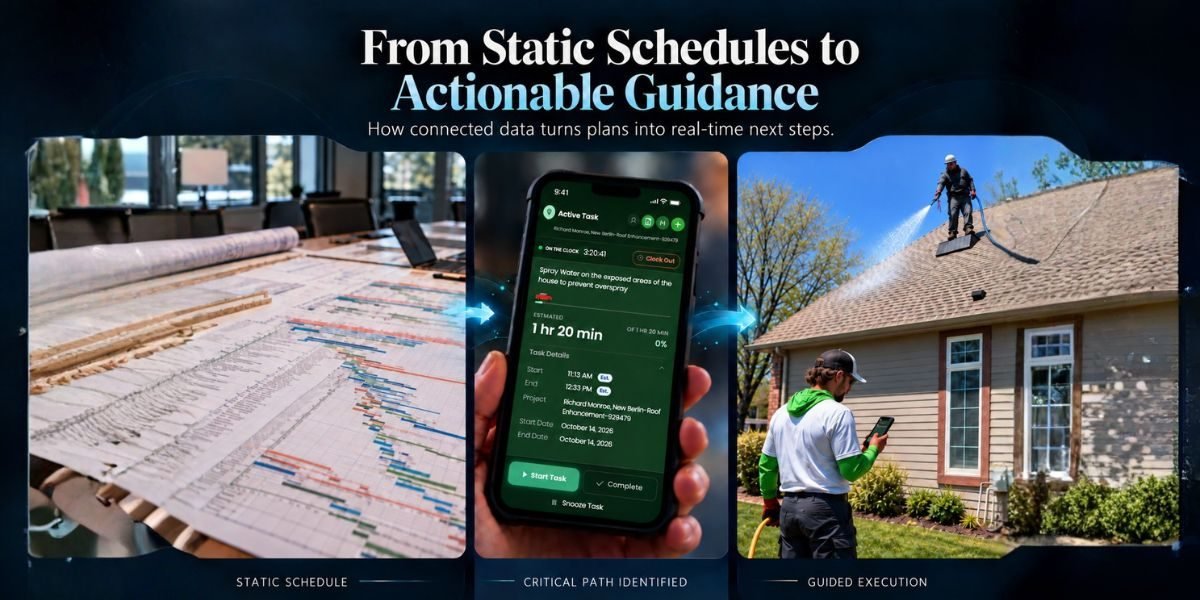
GMS addresses this by functioning like a GPS for contractors. The platform mines a subscriber’s own project history, uses predictive modeling to calculate cost and timeline estimates, provides step-by-step guidance on what to do next, and recalculates automatically when conditions change.
The Hidden Cost of Going It Alone
A growing number of businesses are abandoning SaaS platforms in favor of custom AI-built tools. The appeal is obvious. You pay once, you own it, and you get exactly what you asked for. Or so the thinking goes.
The trend has been dubbed the “SaaSocalypse,” but Stanek believes one part of that movement could backfire.
The problem is not the tool itself. The problem is what happens to the data when everyone builds their own version of the same system. Every contractor running a different custom platform captures project information in a different format. The AI powering each tool can only make decisions based on the data and context it can access. The result is a network of siloed, inconsistently formatted datasets that become increasingly difficult to connect, compare, and learn from at scale.
“When everybody builds their own thing, we end up with all this fuel, and it’s inconsistent,” Stanek says. “AI starts filling the gaps and making assumptions, and we risk ending up with worse information than when we started.”
He uses the analogy of Amazon Marketplace. A seller who builds a beautiful standalone website may have a better product and a better price than what’s available on Amazon. But if they are not selling on Amazon, they are likely missing the majority of buyers who will never find them. The network is an advantage. The standardized data and collective intelligence created across that network become part of the product.
The same logic applies to construction software. When a subcontractor falls behind on one job, that delay ripples across every project they are tied to. GMS cross-connects scheduling data across multiple contractors and organizations. If a shared subcontractor is running over on time at one job site, every connected contractor’s schedule automatically recalculates. That is only possible because the data is being captured in the same place, in a consistent format.
Building for the Fourth Industrial Revolution
One of the most consistent pushbacks Stanek received from early investors was a familiar one: build a sliver, not a full system. Focus on one problem, solve it well, and expand later. He rejected that advice, and he believes the current moment is proving why.
Stanek points to an analogy used by Wildfire Labs founder Todd Gagne, who compared adding AI to legacy systems to “strapping a jet engine to a horse and buggy.” The point resonated with Stanek’s own approach to GMS. “Legacy software was not built to harness artificial intelligence. You can bolt AI features onto it. That doesn’t mean the underlying architecture and data were designed to let AI understand and optimize the entire business.”
Closing that gap can require extensive re-engineering of the underlying architecture and data structures. Because GMS was designed around AI, standardized data, and machine learning from the beginning, it holds a structural advantage that existing players may find difficult to replicate.
The platform recently introduced a three-question estimate feature. Instead of walking a contractor through dozens of inputs, GMS pulls directly from historical contractor data and generates a ballpark cost estimate from just three answers. The more information a user provides, the more accurate the estimate becomes. Every completed project adds historical data that can improve the system’s future predictions.
GMS and its leadership have also earned recognition outside the industry. GMS was named a finalist for the Wisconsin Innovation Awards, placed second in the Wisconsin Governor’s Business Plan Contest, and took first place at Milwaukee’s Founder Fest Pitch Competition. Stanek also took home the Rising Star in Technology award at In Business Madison’s inaugural Executive Excellence: Finance & Technology Awards.
Where the Durable Value Lives
Stanek is not arguing that AI is overhyped. He is arguing that the wrong part of the AI stack is getting the attention.
Access to powerful AI models, he points out, is becoming increasingly democratized. Businesses can now choose among a growing number of highly capable models. What will not be as easily replicated is the private, standardized, industry-specific data and historical context that enable those models to produce more useful outputs.
“Who keeps making all the money?” Stanek asks. “Is it the car manufacturers or the oil manufacturers?”
For GMS, the bet is on the fuel. The company is currently working with beta testers, including a local franchise owner within the national Roof Maxx Company, whose experience with the platform has turned him from a beta user into a potential evangelist: his goal is to use GMS to put more of his own business on autopilot, freeing him to help sell the platform to contractors facing the same challenges he has spent his career navigating.
GMS has a growing waitlist, and it is working to satisfy it as it scales. The platform has already formed network partnerships with companies like Fiserv and EagleView, allowing even the smallest contractors to access pricing and services at volumes typically reserved for large enterprise clients.
The construction industry’s data problem is not unique to construction. Every industry is sitting on private information that could help AI deliver better predictions, inform better decisions, and reduce costly mistakes. The ones who figure out how to standardize, connect, and responsibly leverage that data within trusted networks will not just build better software. They will build the infrastructure that makes AI actually worth the investment.
Tommy Stanek started working on that infrastructure before the AI boom began. He believes the rest of the industry is only now starting to understand what he saw back in 2021.
The goldmine was never in the model. It was always in the data.