

Credit Card Processing Loan Fees: What to Know Before You Sign
Hand one offer to four people and you’ll hear four verdicts. The accountant sees dollars. The cash manager sees a daily drain. The analyst sees an annual percentage. The owner sees what’s left of the profit. Each of them is right, and each of them is missing something on their own.
Credit card processing loans, which are typically repaid through a slice of your daily card settlements, are especially prone to one-lens thinking, because the repayment is automatic and easy to forget. So let’s take a single deal and look at it four ways.
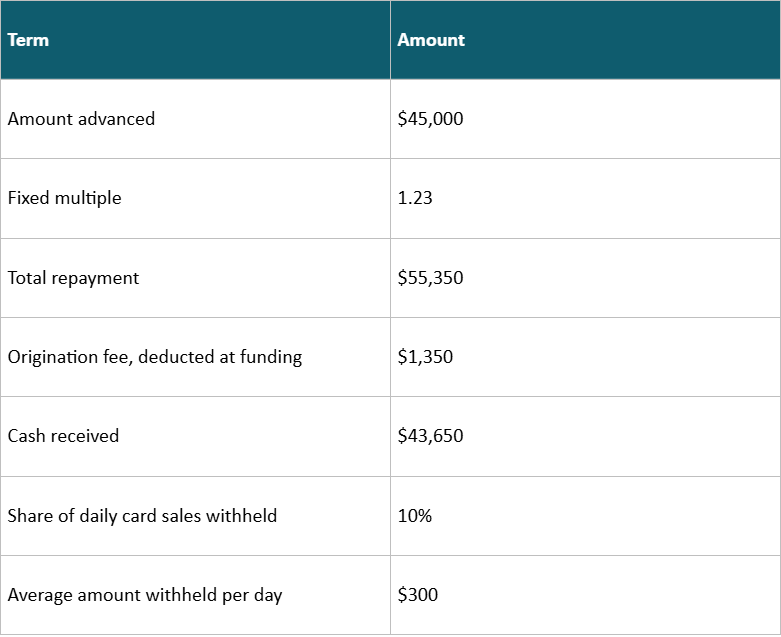
Harbor Street Cycles, a fictional bike shop, runs about $90,000 a month through its card terminal. All numbers below are illustrative.
Before you put an offer under these lenses, read how the product is supposed to work. The Fundivi card processing loan page gives one provider’s description, which you can compare against the language in your own contract.
Then gather every fee. On processing-linked products, charges can appear in places an ordinary loan wouldn’t have them:
- Origination or funding fee, often taken from the proceeds
- Withholding or split fee from the processor for routing settlements
- Monthly servicing fee on the outstanding balance
- Processor change restrictions, sometimes with charges for switching providers
- Early-termination charges on the merchant services agreement
- Returned or failed split charges if a batch doesn’t settle as expected
Harbor Street’s offer includes only the origination fee, which keeps the arithmetic clean. Yours may not.
Lens One: Dollars
Dollar cost = total repayment − amount advanced + upfront fees
For Harbor Street, that’s $55,350 − $45,000 + $1,350 = $11,700. Put another way, 26 cents for every dollar advanced.
What this lens shows: The actual amount leaving the business, which you can compare directly with whatever the money will earn.
What it hides: Time. An $11,700 cost is very different when it’s spread over two years rather than six months. Dollars alone can make a long, expensive product look cheaper than a short, efficient one.
Lens Two: Cost per Day
Card repayment rolls along daily, so a daily view makes sense.
Withholding $300 a day, Harbor Street repays $55,350 in about 184.5 days. Dividing $11,700 by that period gives about $63 of financing cost per day.
What this lens shows: A number you can check against daily profit. If your shop earns $400 a day after expenses, $63 is about one-sixth of it, which is something you can feel.
What it hides: The $300 you hand over each day. The $63 is the cost, but the cash leaving the till is nearly five times that.
Now imagine that sales cool to $70,000 a month. The daily withholding falls to about $233 and repayment stretches to 238 days. The cost per day falls to about $49, even though the total hasn’t changed by one cent. A lower daily figure in that case isn’t good news.
If you’d rather compare against no-collateral lending that doesn’t touch your settlements, this list of no-collateral working capital lenders for merchants is one place to begin your research. Run those offers through the same four lenses.
Lens Three: APR
An annualized estimate lets you compare this deal with products of different lengths. Treating the $43,650 received as the starting point, and $300 a day for 185 calendar days as the repayment, the estimated APR is about 98%.
What this lens shows: The rate at which your money is working against you, on a basis that can be compared with a line of credit or a term loan.
What it hides: Whether the deal makes sense for your purpose. A 98% annualized figure can be perfectly rational for a short, highly profitable use. A much lower one can be a bad idea if the money earns nothing.
There’s an oddity here as well. In the slower sales case, the estimated APR falls to about 76%, even though you’re no better off. APR on percentage-of-sales products depends heavily on the repayment pace, which nobody can know in advance. Treat it as an estimate and ask how any quoted figure was derived.
A term loan might be priced very differently. For a contrasting structure, this Benzinga release on term loan options discusses term products in light of SBA fiscal 2026 lending figures. It’s a company announcement rather than independent analysis.
Lens Four: Share of Profit
This is the lens almost nobody uses, and it’s the one that makes decisions easiest.
Share of profit = dollar cost ÷ gross profit produced by the funds
Harbor Street plans to buy $43,000 of spring inventory. Here’s how three possible seasons would look:
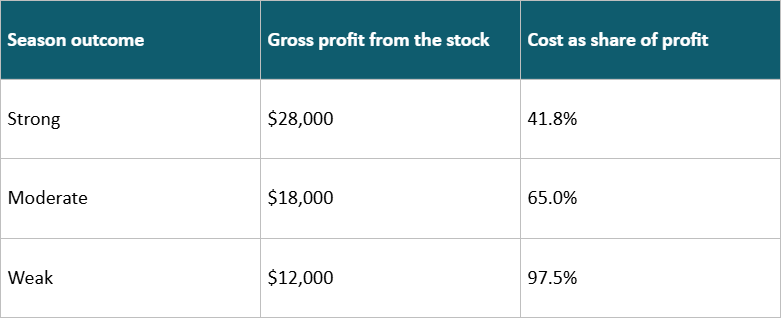
What this lens shows: Who really benefits from the deal. In the weak season, the financing takes nearly the entire gain, and the owner has done months of work for almost nothing.
What it hides: Benefits that aren’t tied to a single purchase, such as keeping the doors open or holding on to a key employee. If the funds are preventing a loss rather than creating a gain, count the loss you’ve avoided.
All Four Together
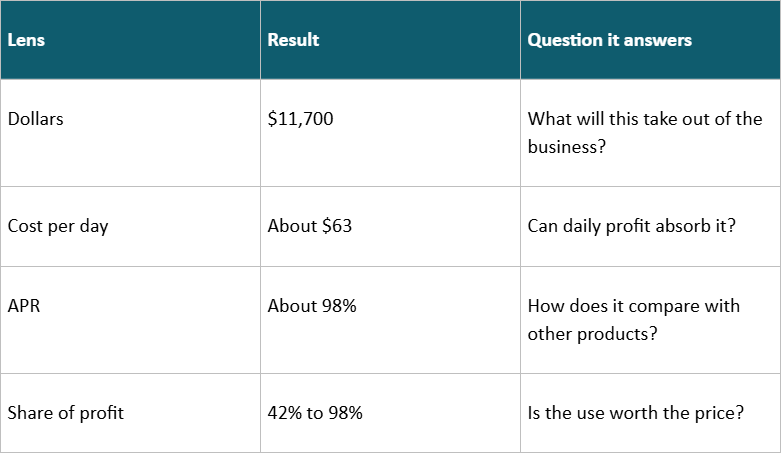
Harbor Street’s owner decided that a $28,000 season was realistic but not guaranteed. Instead of accepting all $45,000, she requested enough to buy only the bikes with the strongest sell-through history. Smaller exposure, same margins, and a lighter daily deduction.
The Renewal Offer: A Fifth Look
Around the halfway point, many merchants hear from their funder again. Suppose that after 92 days, Harbor Street has repaid $27,600 and still owes $27,750. It’s offered a fresh $45,000 at the same 1.23 multiple and the same $1,350 fee.
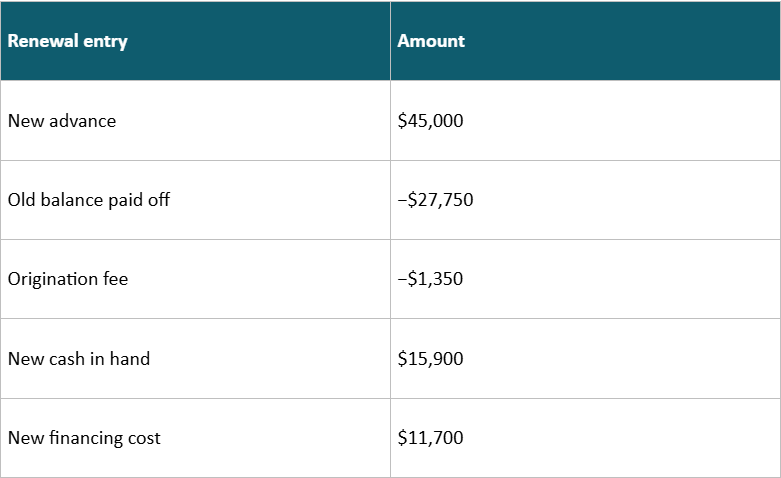
The owner would pay $11,700 to get $15,900 of usable cash, a cost of about 74 cents per new dollar, and the old agreement’s fixed charge isn’t refunded in this example. A renewal can look like a fresh start while being mostly a payoff of your own balance. Always calculate cost against new cash, not the headline amount.
Your processing statements are worth a check as well. Compare the month before funding with the month after, line by line. If new charges have appeared, they belong in your dollar lens.
Questions That Reveal Hidden Fees
Bring these to any card-based financing conversation, and ask for answers in writing:
- Do I have to switch payment processors, and what happens to my current contract?
- Is the withheld share a true percentage of sales, or a fixed amount?
- Are any fees charged monthly, and for how long?
- What’s the total of every charge if repayment lasts longer than expected?
- Is there an early-payoff discount?
- Can I change processors before the balance is paid, and at what cost?
Sites that help you compare lenders can also shape your shortlist. BestMCALoans.com processing fee comparisons is one place to learn about providers in this general space, but a comparison page can’t see your statements, so verify everything in the agreement.
Frequently Asked Questions
How is a card processing loan repaid?
Usually through an automatic share of card settlements. Some providers debit a fixed amount from your bank account instead.
Is the fixed multiple the same as interest?
No. A 1.23 multiple doesn’t equal a 23% annual rate, because the money comes back to the funder within months.
Will I need to change my card processor?
Sometimes. Certain arrangements require it, and switching can trigger charges under your current processing agreement.
What happens in a slow month?
On a true percentage arrangement, withholding falls along with sales, but the total owed doesn’t.
Do processing fees increase while the balance is outstanding?
They can. Compare your processing statement before and after funding.
Should I look at APR or dollars?
Look at both, along with daily cost and profit share. Each one tells you something the others can’t.