

In motorsport, success rarely happens in isolation. It is the result of shared expertise, mutual trust, and the perfect alignment of vision. This philosophy lies at the heart of the alliance between Stallion Motorsports and GOU Racing & Logistics—a partnership that has already begun to redefine how international collaboration can elevate competition in the IMSA Michelin Pilot Challenge’s TCR class.
Announced in late 2025 through an official IMSA release, the partnership between the two organizations marks a historic step for both sides. GOU Racing became the first American OEM-level team to operate the new CUPRA Leon VZ TCR and deliver its first IMSA podium at Virginia International Raceway. Stallion Motorsports now joins forces with GOU to form a cross-continental technical network that connects Brazil, the United States, and Europe.
The collaboration brings together two complementary strengths. GOU contributes extensive race operations knowledge, logistics expertise, and hands-on experience with the CUPRA platform. Stallion, meanwhile, introduces bold vision, marketing innovation, and a new generation of driver leadership through Celso Neto—the young Brazilian-American racer confirmed as the team’s lead driver for 2026. Together, they are described internally as “two constellations aligned.”
As highlighted by Sportscar365, the partnership represents more than a logistical arrangement. It demonstrates a model for the next era of touring car racing—where independent teams operate with OEM-level precision and data integration across continents.
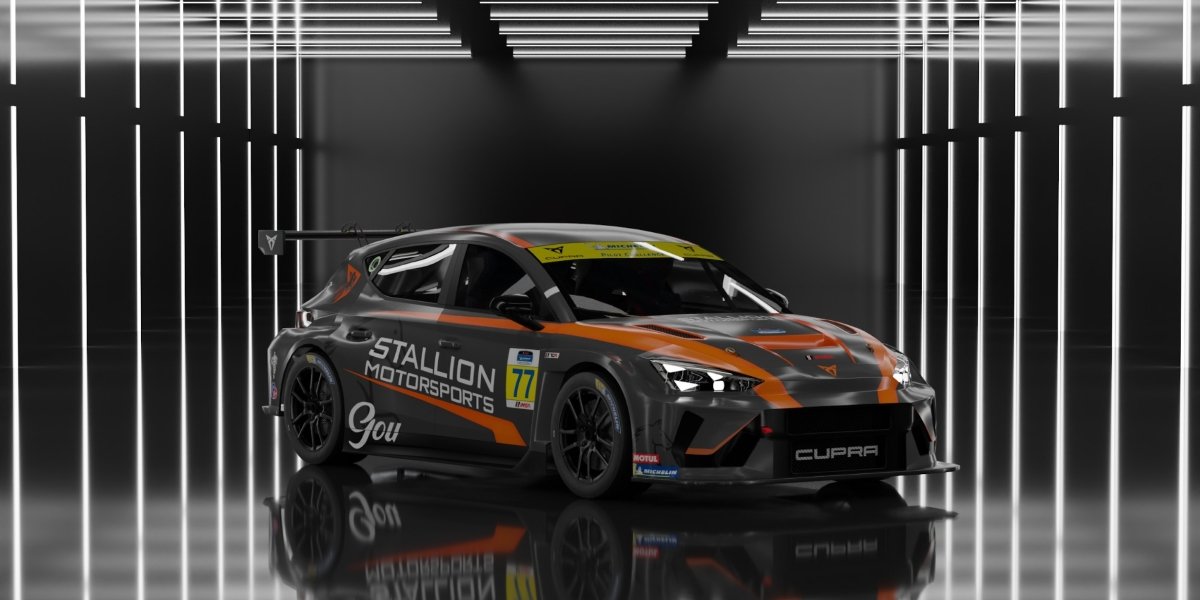
Both teams share not only operational synergy but also visual identity. The color orange, central to both brands, symbolizes energy, determination, and the optimism of progress. Fans have already spotted the signature tone in teaser images and social media posts that hint at the upcoming CUPRA Leon VZ TCR livery. The unified look aims to make Stallion’s #77 car instantly recognizable when it debuts at Daytona in January 2026.
Behind this bold visual statement is a coordinated strategy of engineering collaboration. The CUPRA Leon VZ TCR—imported directly from Spain with support from CUPRA Racing and NGP Motorsports in North America—represents one of the most advanced front-wheel-drive touring cars ever built. Its balance of performance, combined with GOU’s operational expertise, gives Stallion a strong platform to compete immediately in its rookie season.
The technical exchange between the two entities extends beyond the racetrack. Both organizations share telemetry data, testing resources, and component development. This allows Stallion to shorten its learning curve dramatically—achieving competitiveness faster while maintaining reliability throughout the 11-round season.

This cross-continental framework embodies what IMSA has encouraged in recent years: a truly international paddock where innovation meets inclusivity. According to multiple IMSA news features, the arrival of Stallion and its partnership with GOU brings new diversity and business opportunities into the TCR field, enriching the competition’s global appeal.
The alliance also serves as a foundation for future expansion. Stallion has already hinted at the possibility of fielding a second car in 2027, potentially incorporating driver development programs that will connect emerging talent from Brazil and the U.S. The collaboration with GOU ensures that the necessary technical and logistical backbone is already in place.
Beyond technical efficiency, the partnership places strong emphasis on storytelling. Social media plays a vital role in connecting fans to the team’s journey, with vibrant posts and countdowns shared on Instagram and an integrated digital experience via Linktree, where followers can access team updates, news, and behind-the-scenes content. The goal is to showcase not only race results but also the human stories that make this project unique.
At its core, the Stallion–GOU alliance is about evolution. It challenges traditional notions of what defines an “independent team” by introducing factory-level discipline, global collaboration, and unified branding into a program fueled by family passion and technical excellence.
For IMSA fans, this partnership is one to watch closely. As noted by recent coverage on IMSA.com, both teams have proven that success in modern racing is no longer about resources alone—it’s about how well two constellations can align to illuminate the same sky.