
By: Christopher Nolan
In business circles, people talk endlessly about strategy, productivity, and performance. But Meg Tuohey believes one of the most powerful forces shaping a person’s life is something far less visible.
It is the relationship someone has with themselves.
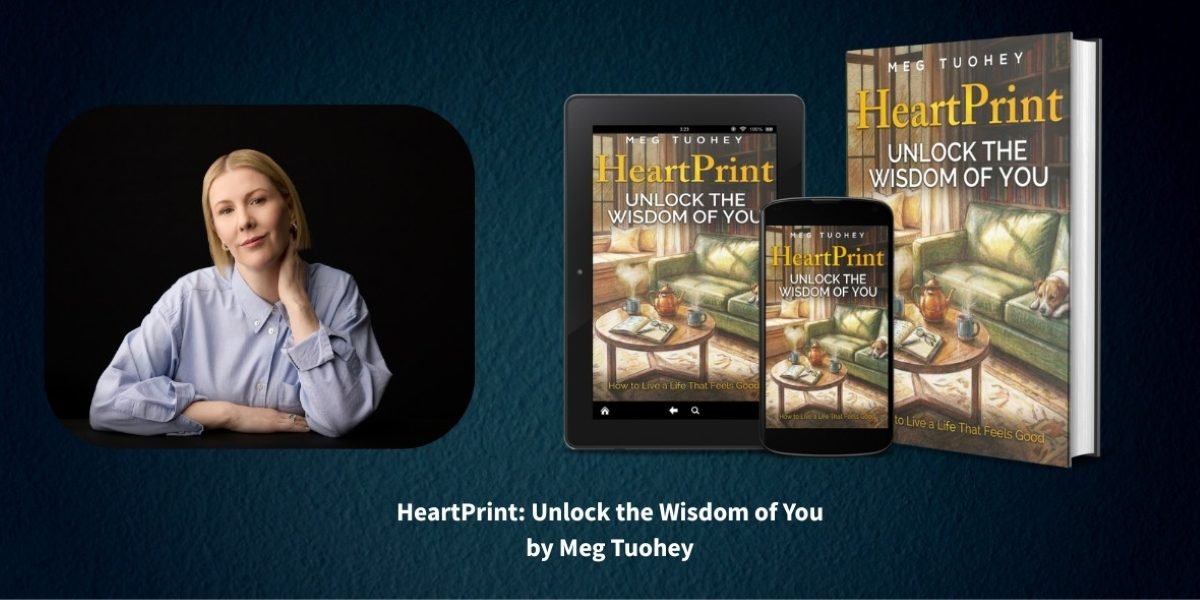
Meg explores this idea in her book HeartPrint: Unlock the Wisdom of You. At its core, the book suggests that every person carries an internal blueprint that quietly guides who they are becoming. Meg calls this blueprint a HeartPrint.
When people learn to recognize it, decisions begin to feel more aligned with the life they want to build.
When they ignore it, life can slowly drift away from who they truly are.
The Idea That Would Not Go Away
Meg did not originally set out to write a book. The concept of HeartPrint emerged through years of working closely with clients and observing patterns in how people grow and change.
Over time, the idea began to feel bigger than one-on-one conversations.
“It felt like Elizabeth, the Wise Woman in the book, tapped me on the shoulder and set things in motion,” Meg explains.
Elizabeth becomes an important figure in the story, guiding the main character Ellie through moments of uncertainty and self-discovery.
Meg saw the book as a way to bring the insights she had gathered through her work to a wider audience.
“I felt the calling of my own HeartPrint to share the wisdom I had curated,” she says.
Why Storytelling Became the Framework
Many personal growth books rely on instruction. Meg chose a different approach.
Instead of presenting ideas as lessons, she built the book around a narrative. Readers follow Ellie through the experiences that shape her life, from early challenges to later moments of reflection and wisdom.
Meg believes this structure allows readers to engage with the ideas more personally.
“I wanted readers to see themselves in the characters,” she explains. “Whether they agree or disagree with Ellie’s choices, they can step into her perspective and learn alongside her.”
The result is a book that feels less like a manual and more like a lived journey.
How Disconnection Begins
One of the most powerful themes in HeartPrint is the idea that people start life naturally connected to themselves.
As children, most individuals instinctively trust their emotions, instincts, and curiosity.
But life introduces challenges.
Rejection. Loss. Pain. Experiences that leave a mark.
Without guidance to help process those moments, people often develop coping strategies designed to protect themselves.
“We create ways to keep ourselves safe,” Meg explains. “Those parts of us can get in the way of accessing our HeartPrint because we are focused on simply keeping our heads above water.”
Sometimes a single difficult event triggers this shift. Other times it happens slowly through smaller experiences that accumulate over time.
Eventually, many people reach a point where the disconnection becomes too uncomfortable to ignore.
For some, that moment appears during midlife.
The pressure of responsibilities, relationships, and expectations reaches a tipping point, forcing deeper reflection.
Meg’s Own Turning Point
Meg experienced her own distance from her HeartPrint early in life.
She remembers two defining moments.
The first occurred when she was seven years old. The second came at nineteen. Both involved experiences that left her feeling as though life might never return to normal.
“I patched myself together both times,” she recalls.
But the deeper process of healing did not begin until later.
At twenty-seven, Meg started exploring the emotional layers beneath those experiences and reconnecting with her inner voice.
That process eventually shaped the ideas that appear throughout HeartPrint.
Why Slowing Down Feels Uncomfortable
A central theme in the book is the importance of slowing down long enough to hear what is happening internally.
In a fast-moving world, that simple act can feel surprisingly difficult.
Meg believes part of the challenge lies in how modern life has evolved.
Previous generations often had stronger connections to elders who helped guide them through emotional transitions.
Today, many people navigate those experiences alone.
“Our grandparents’ generation often had more access to elder wisdom,” Meg says. “That kind of guidance has faded in many places.”
When people slow down without support, emotions that have been pushed aside often rise to the surface.
The mind can interpret those feelings as something threatening.
And when something feels threatening, the instinct is to avoid it.
In the book, Elizabeth plays the role of a guide who helps translate those emotions into insight rather than fear.
The Role of Self-Compassion
Another key message in HeartPrint centers on self-compassion.
Meg believes many people carry an internal critic that speaks far more harshly than any external voice.
Replacing that criticism with curiosity and kindness can transform how someone processes life experiences.
“Self-compassion is one of the great antidotes to the pain and confusion of being human,” she says.
Elizabeth models that voice throughout the story, offering Ellie perspective instead of judgment.
For readers who have never developed that kind of internal dialogue, the character becomes a temporary guide until they learn to cultivate their own.
What Living Your HeartPrint Looks Like
The idea of aligning with a HeartPrint might sound philosophical, but Meg describes it in very practical terms.
It begins with a simple question.
Is the next action I take moving me toward the life and relationships I truly want?
Sometimes the answer leads to small adjustments.
Other times it reveals that bigger changes may be necessary.
Either way, the process invites people to move through life with greater awareness.
The Power of Small Change
Meg does not expect readers to reinvent themselves after finishing the book.
Her goal is more modest and more realistic.
She hopes readers will experience a shift of about ten percent.
Ten percent more authentic.
Ten percent are kinder toward themselves.
Ten percent braver about expressing who they really are.
Those small shifts accumulate over time.
And gradually, they begin to shape a life that feels more aligned with their deeper values.
A Story That May Continue
Although HeartPrint offers a complete journey through Ellie’s life, Meg believes the story may not be finished.
There are still parts of Ellie’s life waiting to be explored.
Future books could focus on Ellie’s relationship with her husband, Joe, or delve deeper into the histories of her parents and grandparents.
For Meg, those possibilities feel exciting.
“HeartPrint is just the beginning,” she says.
Her hope is that Ellie’s story continues to reach new readers and spark conversations about intuition, identity, and the courage required to live honestly.
Because sometimes the most powerful leadership decision a person can make is surprisingly personal.
It is the choice to listen to the quiet wisdom already living inside them.
You can find Meg Tuohey’s book HeartPrint: Unlock the Wisdom of You on Amazon or Barnes & Noble, offering a thoughtful path toward deeper self-discovery.