
By: Ben Walker
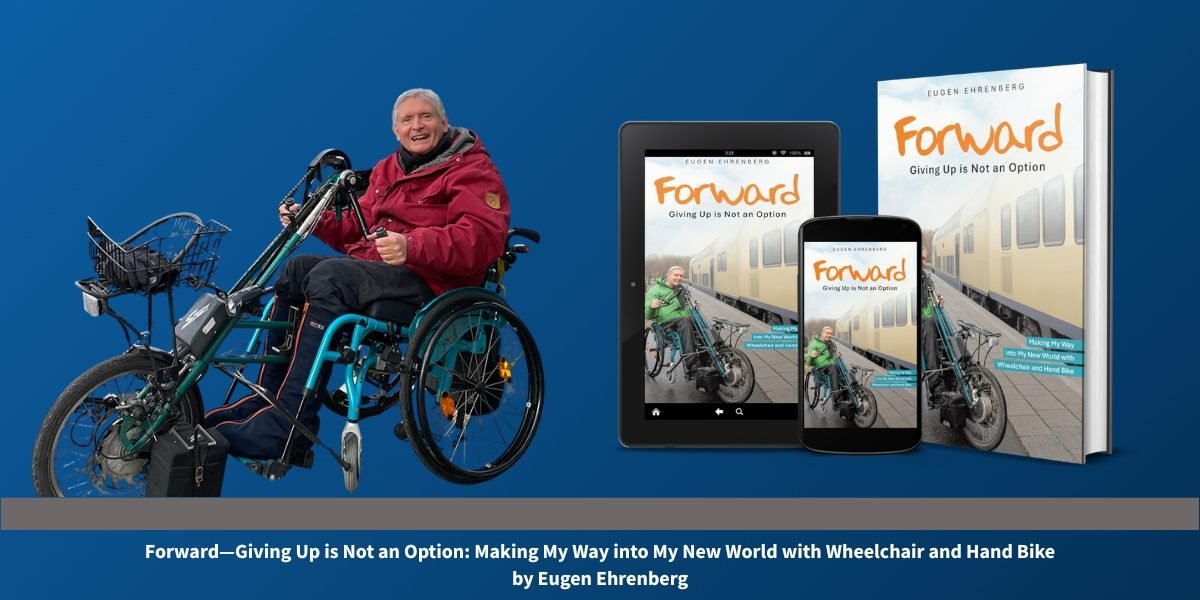
Eugen does not write from theory. He writes from impact, from the kind of life shift that doesn’t politely knock first. His book Forward Giving Up is Not an Option comes from years of lived friction, not polished hindsight.
At first, his stories were just that, stories. Shared with friends, often funny, sometimes uncomfortable, always real. Adventures on a wheelchair hand bike that could swing from absurd to frustrating in minutes. People laughed. People stared. Some were shocked. And slowly, a pattern emerged. These weren’t just anecdotes. They were proof of something bigger.
That life doesn’t stop. It just changes shape.
The Moment Before Letting Go
There is a quiet, almost cinematic moment Eugen describes. The book is done. The cursor hovers. One click away from being sent out into the world.
And then hesitation.
Not because of doubt in the story, but because of what it reveals. The fear, the weakness, the messy parts most people edit out. Publishing meant exposure in the rawest sense. Not just showing strength, but showing everything that came before it.
He paused. Not briefly.
That hesitation says a lot. This is not a story built to impress. It is one that risks discomfort.
A Slow Shift, Then a Hard Stop
When Eugen was first diagnosed with multiple sclerosis in the early 90s, it did not feel like a defining moment. There was no internet, no flood of information, no immediate sense of gravity. Symptoms came and went. Life continued.
For a while, nothing really changed.
Until it did.
The shift was gradual at first. Small limitations. Adjustments. Then a harder realization began to settle in. The things he loved, working outdoors, physical labor, and long days in the fields, started slipping away.
Letting go of that identity hit harder than the diagnosis itself.
Then came 2011. An accident. And suddenly, the idea of using a wheelchair was no longer theoretical. It was immediate, unavoidable, and deeply personal.
That was the real shock.
Losing Ground, Finding Direction
Eugen doesn’t pretend that strength was always there. He is clear about that.
There were moments when the will to keep going wasn’t strong. Moments that leaned dangerously close to giving up. The kind of emotional exhaustion that doesn’t make for inspirational quotes.
But something shifted, not all at once, but through repetition.
Challenge after challenge.
A broken elevator at midnight. A missed train connection. The frustration of navigating spaces not built for him. None of these moments looked like breakthroughs. But they built something quietly.
Composure.
And from that composure, strength.
The Hand Bike That Changed Everything
The turning point wasn’t dramatic in the traditional sense. It didn’t come with a big announcement or a clean transformation arc.
It came with movement.
Discovering the wheelchair hand bike gave Eugen something he hadn’t felt in a long time. Independence. Not in theory, but in action. The ability to go somewhere without waiting, without asking, without negotiating every step.
That changed everything.
Suddenly, distance shrank. Possibilities expanded. What once felt restrictive started to open again.
Freedom didn’t return in its old form. It came back redesigned.
Redefining Freedom
Before all of this, freedom was something Eugen barely thought about. It existed, so it didn’t need attention. It was personal, contained within his own life.
Now, it feels different.
Freedom is no longer just individual. It is shared. It is fragile. It is something that needs to be protected, not assumed.
There is a deeper awareness now. Not just of his own movement, but of how systems, spaces, and attitudes shape what is possible for others too.
That shift in perspective runs quietly underneath the entire book.
Fear, Then Familiarity
One of the less-talked-about challenges is fear. Not the dramatic kind, but the constant, low-level anxiety of being stuck somewhere, of not knowing how to navigate a situation, of relying on things that might not work.
Public spaces become unpredictable.
Travel feels complicated.
Even simple decisions carry weight.
Eugen describes how that fear slowly lost its grip. Not because it disappeared, but because experience replaced uncertainty. The more he moved, the more he learned. The more he learned, the less power fear had.
Now, traveling long distances, even up to 20 kilometers (12.5 miles) or even more, with his hand bike, feels normal.
That did not happen overnight.
Humor as Survival
There is something unexpected in Eugen’s story. Humor.
Not forced positivity. Not denial. Real humor.
He laughs at broken elevators. In inconvenient situations. At the absurdity of things going wrong in familiar ways.
There is a story about an elevator at Hamburg Central Station. It stops working right after someone uses it. The other person is shocked. Eugen laughs.
Not because it is funny in the usual sense. But because he has seen it before. Many times.
Without humor, those moments would pile up differently. He is clear about that.
Humor doesn’t fix the problem. But it changes how you carry it.
The Discipline of Not Giving Up
“Giving up is not an option” is not just a title. It is a practiced mindset.
Not blind optimism. Not a denial of difficulty. It is more practical than that.
It starts with staying calm. Looking at the situation without immediately jumping to the worst-case scenario. Giving time for perspective to shift.
Sometimes that means doing nothing for a moment. Sitting down. Having a hot drink. Sleeping on it.
Then, try again.
There is something grounded in that approach. It removes the pressure of instant solutions and replaces it with persistence.
Who This Story Is Really For
Eugen originally wrote the book for people curious about his journey. Friends, acquaintances, anyone who had heard the stories.
But the response changed that understanding.
Readers in wheelchairs saw something else. A kind of roadmap. Not a perfect one, but a real one.
Others, people facing entirely different struggles, found something just as relevant. Not the specifics, but the mindset.
The idea that even when life shifts without permission, there is still a way forward.
What Stays With You
There is a story about a technician who repaired Eugen’s hand bike. After reading the book, he signed up for training. Not because he had to, but because something clicked.
“If he can do it, so can I.”
That reaction says more than any review could.
Eugen’s story doesn’t promise easy outcomes. It doesn’t smooth over the difficult parts. What it offers is something more durable.
Proof that strength can grow after it disappears.
Proof that freedom can return in a different form.
And maybe most importantly, a reminder that even when everything feels upside down, the story is not finished.
For more information, visit his official website: https://www.eugenehrenberg.com/ or find his book on Amazon.