
By: Darius Cole
Hip-hop has never been satisfied with remaining music.
It became fashion almost as quickly as it became records. It became dance, language, visual art, film, television, advertising and eventually a worldwide culture. Every generation has found another screen on which hip-hop could project itself. For DPB, one of Christian rap’s longtime practitioners, that next screen may literally be a screen.
Maybe two of them.
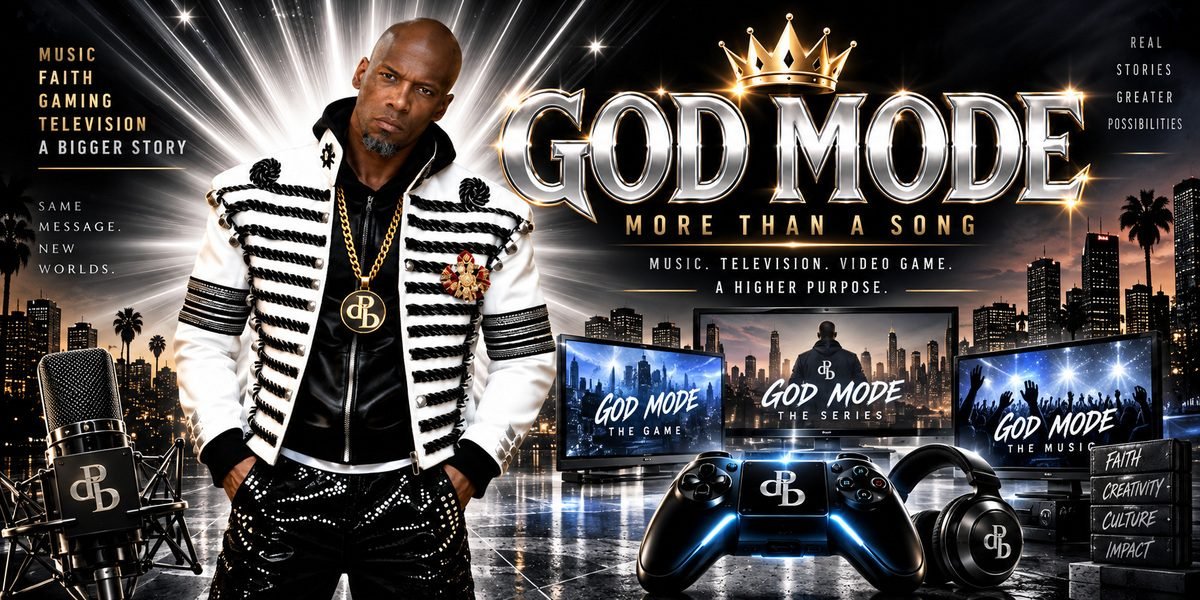
With “God Mode,” DPB is exploring the possibility that a song can become more than something listeners stream. The concept could eventually provide the foundation for both a video game and television spinoff, extending the spiritual metaphor at the heart of the record into interactive and narrative entertainment.
Those projects remain possibilities rather than formally announced productions, but the direction is revealing. DPB is thinking less like an artist promoting another single and more like a creator asking how far one idea can travel.
And “God Mode” certainly arrives with an idea.
The track appears on DPB’s 15-song 2026 album Undefeated, although its history predates the project: the original “God Mode” and its radio edit were released in 2022. Its inclusion on Undefeated has given the song another life, with a renewed 2026 radio campaign taking it to No. 2 on Christian Music Weekly’s Rhythmic Airplay chart.
Its central metaphor comes directly from gaming.
Anyone who grew up punching codes into controllers understands the fantasy. God Mode means the ordinary rules suddenly stop applying. Damage doesn’t matter. Your character possesses extraordinary power. The limitations governing everybody else have been suspended.
DPB turns that digital fantasy into theology.
His version isn’t about making David Brooks invincible. Instead, he uses the phrase to describe his belief that Christians possess spiritual authority through Christ. The song distills the whole concept into an almost absurdly efficient piece of pop-cultural theology: “Jesus Christ is the God Code.”
That line is bigger than a hook because it immediately creates imagery.
You can see the game.
According to DPB, the concept originated after he prayed about what message he should communicate next and subsequently experienced a dream in which he received the idea that believers were continually praying for future power without recognizing what God had already given them for the present.
That story explains the urgency of the record.
DPB isn’t performing uncertainty. “God Mode” is built from declarations: healing, freedom, deliverance, revival. Hip-hop swagger gets repurposed as testimony. The traditional MC says, Look at my power. DPB’s variation is essentially, Look where my power comes from.
Recent reviews have recognized that unusual collision. 24Hip-Hop described the record as operating almost like a chant, while VENTS noted its combination of hip-hop energy and revival-meeting intensity.
There is historical logic to that combination.
Hip-hop and the Black church have always shared more DNA than genre classifications acknowledge. Both understand testimony. Both understand call-and-response. Both understand the ability of repetition to transform individual expression into communal participation. The preacher asks for an amen. The MC tells everybody to throw their hands up.
Different language. Similar mechanics.
DPB has lived somewhere around that intersection for more than three decades, long enough to remember when Christian rap itself required explanation. Now he’s contemplating another transition: from MC to multimedia storyteller.
The potential “God Mode” video game is the most obvious extension.
Imagine translating the song’s underlying themes; faith, choices, adversity, spiritual battles, perseverance, and empowerment, into challenges a player experiences rather than lyrics a listener hears. The music no longer accompanies the experience. The music becomes the doorway into it.
That’s an increasingly important distinction for independent artists trying to build audiences in a streaming economy where millions of songs compete for attention.
A game can create something Spotify cannot: participation.
The television possibility opens another avenue. “God Mode” already contains the skeleton of a narrative universe, ordinary people confronting extraordinary obstacles and discovering that what they need to overcome them has been available all along. How that might eventually translate into characters, episodes, or story arcs remains undecided, but the concept lends itself naturally to episodic storytelling.
For now, both ideas should be understood as potential extensions of the “God Mode” concept, not finished productions with announced premiere dates.
That distinction doesn’t make them less interesting.
It may make them more so.
DPB’s current moment demonstrates what independence can mean when artists stop defining themselves exclusively by recordings. His 2026 campaign has already produced measurable radio momentum. “God Mode” followed “Back in the Day,” which spent seven consecutive weeks at No. 1 on the National Radio Hits AC40 chart, according to Spins Tracking System.
But charts measure the reach of a song.
DPB now appears interested in measuring the reach of an idea.
There is something appropriate about that happening with an album called Undefeated. Apple Music lists the March 9 release as a 15-track collection, and reviews have characterized it as a mixture of testimony, nostalgia, celebration, and spiritual perseverance.
DPB has spent decades adapting while keeping his central message remarkably consistent. The technology changes. The delivery systems change. Hip-hop changes. The audience changes.
The mission doesn’t.
And that may ultimately be the most interesting thing about a “God Mode” television series or video game. They wouldn’t necessarily represent DPB abandoning music for another industry.
They would represent him recognizing something hip-hop figured out a long time ago:
The record doesn’t have to be the destination.
Sometimes it’s the portal.