
This case file follows a fictional but representative business through a debt consolidation decision. It is structured the way an advisor might document a client engagement: situation, diagnosis, options, decision, and results. Figures are illustrative.
1. The Situation
- Business: Family-owned auto repair shop, eight years in operation
- Annual revenue: About $1.1 million
- Owner: Second-generation operator with solid industry experience
- Presenting problem: “We’re busy every day, but there’s never any money in the account.”
Over the previous eighteen months, the shop had taken on several financing products in quick succession, mostly in response to urgent needs: a lift replacement, a slow winter, and a large parts order. Each decision made sense at the moment. Together, they created a serious cash flow squeeze.
Current obligations:
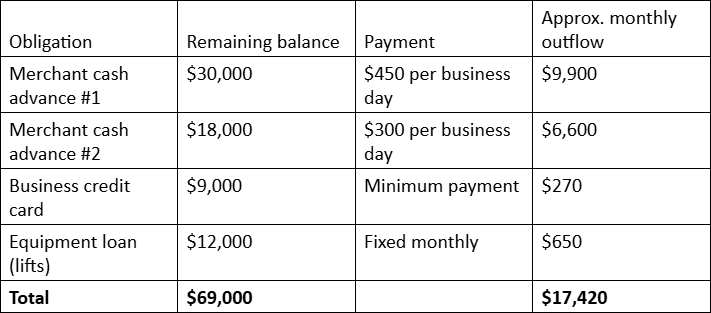
The two advances alone pulled more than $16,000 out of the business every month, debited daily.
2. The Diagnosis
The shop’s underlying business was healthy. Gross margins were in line with industry norms, customer retention was strong, and revenue had grown modestly year over year. The problem was not profitability; it was the structure of the debt.
Three issues stood out:
Daily debits were draining operating cash. Because the advances collected every business day, the shop rarely built a cushion. Any slow week immediately pressured payroll and parts purchases.
Stacking had compounded the strain. The second advance was taken partly to cover the payments on the first. This is a common pattern, and it tends to accelerate rather than relieve pressure.
Short repayment windows magnified the effective cost. Both advances were scheduled to be repaid within months, which meant high annualized costs and intense short-term cash demands.
No one was watching the full picture. The owner tracked each obligation separately and had never added up the total monthly outflow. Seeing $17,420 on a single line was, in the owner’s words, a wake-up call. Many business owners in similar situations underestimate their total debt service until they list everything in one place.
3. The Options
The owner and advisor evaluated four paths.
Option A: Ride it out. Continue the current payments until the advances are repaid in roughly three to four months. This would avoid new borrowing costs but risk missed payroll or supplier payments in the meantime.
Option B: Negotiate with existing providers. Ask the advance providers for reconciliation or temporarily reduced payments based on actual revenue. This could provide short-term relief if the contracts allowed it. Providers are not always obligated to agree, but many prefer adjusted payments to the risk of default, particularly when the owner communicates early and supplies current bank statements showing the revenue decline.
Option C: Consolidate into a term loan. Use a single term loan with a longer repayment period and monthly payments to pay off both advances and the credit card, keeping the equipment loan in place.
Option D: Combine B and C. Seek temporary relief while applying for consolidation financing.
4. The Analysis
The advisor modeled Option C using a hypothetical $57,000 consolidation loan over three years at an illustrative rate.
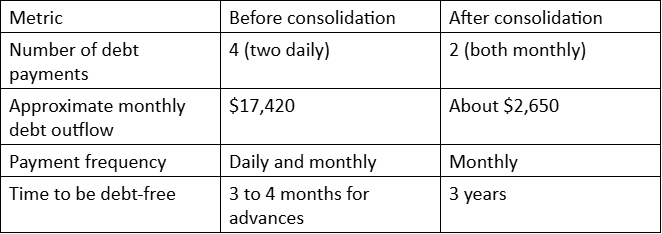
The monthly relief was dramatic. But the advisor was careful to explain the trade-off honestly: stretching repayment over three years would likely increase the total dollars paid in financing costs, even though the annualized rate was far lower. The advances would have been finished in a few months; the consolidation loan would last three years.
The key question was not “which is cheaper in total?” but “which structure lets the business operate safely and grow?” With roughly $14,000 per month freed up, the shop could rebuild reserves, pay suppliers on time to earn early-payment discounts, and avoid any further stacking. The advisor also noted that the shop could make extra payments on the new loan during strong months, provided the agreement allowed early repayment without penalty, which would shorten the term and reduce total interest.
5. The Research
Before applying, the owner researched lenders that offer consolidation and refinancing loans to businesses with existing advances. Not all lenders will refinance merchant cash advances, and those that do vary in requirements, rates, and how they handle payoff logistics.
The owner used Compare Business Loans Online to understand how term loans compared with other consolidation approaches and reviewed provider reputations on Best Rated Business Loans. To better understand the advance contracts already in place, including reconciliation rights and payoff terms, the owner read through explanations at Best MCA Loans. Business Loans Engine helped clarify the eligibility criteria the shop would need to meet.
6. The Decision
The owner pursued Option D. First, they contacted the advance providers to request payoff letters and asked about reconciliation. One provider agreed to a temporary payment adjustment while the consolidation was arranged.
Next came a critical choice: where to apply. Under stress, the owner’s first impulse had been to submit applications to every lender offering “debt consolidation” online. The advisor strongly discouraged this. Businesses already carrying stacked advances are often contacted by aggressive brokers, and spreading applications widely tends to trigger multiple hard inquiries, attract even more high-cost offers, and make legitimate lenders more cautious about a file that appears to be shopped everywhere. In a situation like this, one more bad decision could make things far worse.
Instead, the owner selected the single lender whose consolidation program best matched the shop’s revenue, time in business, and credit profile, and submitted one complete application with:
- Six months of bank statements
- Two years of business tax returns
- A current profit and loss statement and balance sheet
- A debt schedule listing every obligation with balances and payoff letters
- A brief explanation of how the advances had accumulated and how consolidation would stabilize operations
7. The Result
The application was approved after a short review. At closing, the lender paid off both advances and the credit card directly. The shop moved from daily debits to a single monthly payment, plus the existing equipment loan.
Six months later:
- The shop had built a cash reserve covering about one month of operating expenses
- Supplier payments were on time, and the owner captured early-payment discounts on parts
- No new advances had been taken
- The owner had opened a small line of credit to handle future slow periods, rather than turning to high-cost products again
Reflecting on the experience, the owner noted that the hardest part was not the paperwork. It was slowing down long enough to look at every obligation on one page and admit that the pattern had to stop.
8. Lessons From the Case
Diagnose structure, not just balances. The shop’s total debt was manageable; the payment structure was not.
Stop the stacking. Taking a new advance to pay an old one rarely ends well and usually deepens the hole.
Be honest about trade-offs. Consolidation may raise total cost while improving cash flow. Both facts matter.
Read your existing contracts. Reconciliation rights and payoff terms can create options you did not know you had.
Research carefully, then apply once. Especially under financial pressure, a focused application to the best-fit lender protects your credit and your decision-making.
Build a safety net afterward. Reserves and a modest line of credit help prevent the cycle from repeating.
Warning Signs Your Debt Structure Needs Attention
You may be facing a similar situation if:
- Daily or weekly debits regularly leave your account near zero
- You have considered, or taken, new financing to make payments on existing financing
- Revenue is steady or growing, yet you struggle to pay suppliers or yourself
- You no longer know your exact total debt or every payoff date
- You avoid opening bank statements because of what they might show
Any one of these deserves a closer look. Several together suggest it is time to sit down with your numbers, and perhaps an advisor, before the situation narrows your options further.
Closing Note
Debt consolidation is not a cure for an unprofitable business, and it is not always the cheapest path in total dollars. But for a healthy business trapped in a punishing repayment structure, it can be the difference between constant crisis and steady growth. The key is to understand the numbers, weigh the trade-offs honestly, research lenders thoroughly, and commit to the single provider best equipped to help your business regain its footing.