
Cryptographically Bound, Policy-Enforced, and Forensically Replayable AI Agents Examined Through a Mock Trial
Google’s Agent Development Kit (ADK) provides a coherent and well-engineered foundation for building, evaluating, and deploying AI agents. It performs strongly in research and prototyping work, but it does not yet ship with the controls that production enterprises depend on,identity-bound execution, cryptographic provenance, runtime policy enforcement, and tamper-resistant audit trails. This paper introduces SecureADK, an extension of ADK built on the conviction that security must be woven in from the start rather than applied later as a patch. SecureADK adds zero-trust runtime enforcement, dataset sealing through OmniSeal, and ledger-anchored provenance via Hyperledger. To put the contrast on display, we follow a courtroom orchestration use case through two runs, one on plain ADK, one on SecureADK, and compare what each produces. The lesson is that ADK enables agents to collaborate, while SecureADK renders those collaborations verifiable, auditable, and acceptable to regulators across fields such as the judiciary, healthcare, finance, critical infrastructure, law enforcement, and defense.
AI agents are now being assigned increasingly weighty work, including legal reasoning, clinical decision support, financial automation, and regulatory reporting. Systems serving such fields must clear a high bar: deterministic reproducibility, identity attribution, evidentiary integrity, non-repudiation, policy governance, and forensic traceability. Vanilla ADK orchestration does not deliver these properties on its own. SecureADK is purpose-built to fill that gap by embedding security, governance, and provenance directly into the agent runtime.
A Mock Trial as a Trust Stress Test
A simulated courtroom is an unusually demanding setting,high-stakes, multi-agent, and structurally adversarial, which is exactly what makes it such a strong proving ground for trust requirements. The cast of agents typically includes a judge, prosecution counsel, defense counsel, a medical expert, jurors, a clerk, and an evidence processor. They must hand evidence between parties, argue logically, retrieve documents, reach decisions, and produce verdicts that can withstand later examination. The pressure profile closely matches what regulated enterprise AI systems encounter in everyday operation.
The Trial on Vanilla ADK
Operating Pattern
A baseline ADK courtroom run begins with the user opening the trial. Agents then exchange prompts, call tools directly, evaluators score the outputs, and a verdict is emitted at the end.
Where the Weaknesses Surface

Sample Breakdowns
- The defense agent silently rewrites a piece of evidence.
- The medical agent relies on a dataset whose origin has never been confirmed.
- A juror’s reasoning chain is not replayable.
- Tools fire without first verifying the caller is authorized.
- The final verdict cannot be audited.
The implication is direct: an ADK-only stack is acceptable for demonstrations, but it does not hold up in a real courtroom or under regulatory scrutiny.
A Look Inside SecureADK
Defense-in-Depth Construction
SecureADK is organized around a layered architecture, with each layer carrying a clearly scoped responsibility:

The Trial on SecureADK
Hardened Execution Path
- Each agent is provisioned with a cryptographic identity.
- Evidence items are sealed under OmniSeal™.
- Tool invocations must clear a policy gate before they proceed.
- Evaluations are stamped with cryptographic signatures.
- Every interaction is committed to the ledger.
- The verdict is sealed and fully reproducible.
Security Properties Delivered
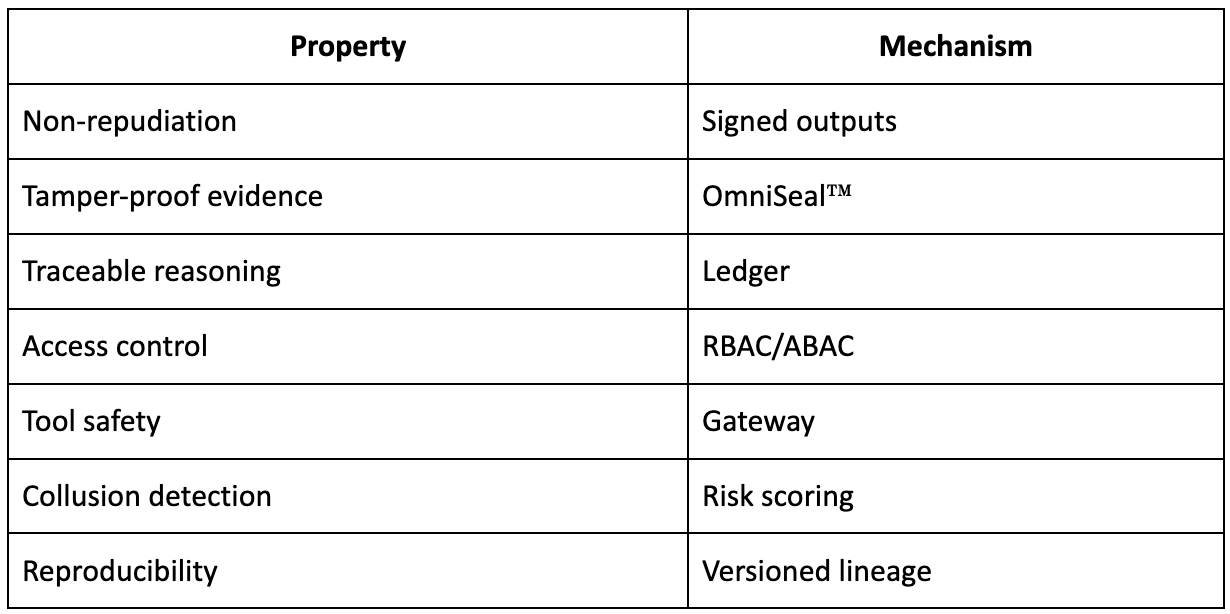
A Hardened Trial in Action
- Evidence Handling: Each item is uploaded, sealed, hashed, and accompanied by a corresponding ledger entry.
- Prosecution Access: The agent’s identity is authenticated, policy compliance is checked, and access is confined to read-only.
- Medical Expert: The dataset version is certified, and the evaluation is digitally signed.
- Verdict: The judge agent signs the verdict; every contributing input is bound to it, and the entire chain remains auditable.
Capability Comparison
The table below sets the two stacks side by side:

Formal Properties Introduced
SecureADK contributes a set of formal properties to the orchestration environment:
- Integrity: Every artifact is cryptographically sealed.
- Accountability: Every action is bound to a specific identity.
- Determinism: Decision graphs can be replayed.
- Governance: Policy-as-code is enforced at runtime.
- Auditability: An immutable provenance ledger keeps the full record transparent.
- Isolation: Tenant boundaries and sandboxing are preserved.
Wider Significance
- Legal Systems: SecureADK supports evidence admissibility and reproducible verdicts.
- Healthcare: Enables HIPAA-compliant AI reasoning.
- Finance: Underpins auditable trading agents.
- Defense: Establishes trusted command chains.
With SecureADK in place, an existing multi-agent ADK courtroom stack is lifted from simulation-grade to forensic-grade, regulator-ready infrastructure.
Final Reflections
SecureADK serves as a security and governance layer on top of ADK. ADK provides the orchestration backbone for AI agents, but it does not address the trust, compliance, and audit requirements that enterprise and regulated environments impose on a system. SecureADK closes that gap by adding data sealing, signed reasoning, enforced identity, comprehensive provenance logging, and regulatory compliance. Both layers are indispensable: ADK provides the core intelligence and operational backbone, while SecureADK keeps those operations trustworthy, compliant, and auditable, producing a combined system fit for high-stakes, production-grade AI deployments.
About PureCipher Inc.
PureCipher is a leader in AI security and data integrity, dedicated to safeguarding national interests through advanced, quantum-resilient technologies. Its Artificial Immune System™ platform includes OmniSeal™,a patent-pending tamper-evident technology,together with Noise-Based Communication for stealth transmission, Fully Homomorphic Encryption (FHE)–enabled AI processing, and secure, transparent AI agents. Drawing on deep expertise in AI, quantum computing, and cybersecurity, PureCipher™ pursues its mission to build a safer, more trustworthy world.
Contact: PureCipher™ Communications
Email: media@purecipher.com
Website: www.purecipher.com