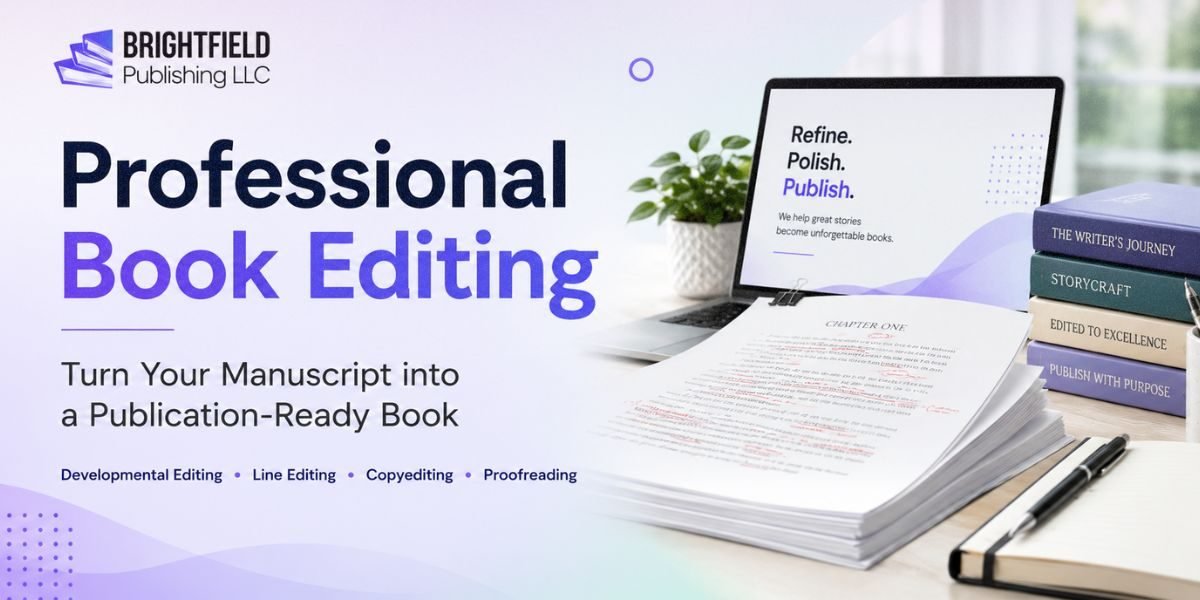

Writing a book is an achievement, but finishing the first draft is only the beginning. Before a manuscript reaches readers, it needs refinement and polishing. Professional book editing helps authors strengthen their ideas, improve readability, correct errors, and prepare their work for publication. At Bright Field Publishing LLC, book editing is approached as a collaborative process designed to protect the author’s voice while improving the manuscript’s clarity, consistency, structure, and overall quality.
Why Professional Book Editing Matters
Authors often become familiar with their own writing. After reading the same chapters repeatedly, it can be difficult to notice unclear passages, repetition, missing information, pacing issues, or grammar errors. A professional book editor provides a perspective and identifies issues that may distract readers or weaken the message.
Book editing is not about replacing an author’s style. It is about helping that style communicate more effectively. A skilled editor studies the manuscript, understands its purpose, and makes improvements that support the author’s vision. Whether the book is fiction, nonfiction, memoir, biography, children’s literature, or faith-based writing, professional editing can help create a smoother and more engaging reading experience.
Developmental Editing for Structure and Content
Developmental editing focuses on the big picture. It examines how the manuscript works, instead of individual sentences. For fiction, this may include plot development, character motivation, dialogue, pacing, setting, conflict, and chapter organization. For nonfiction, developmental editing may address argument structure, topic order, repetition, supporting information, transitions, and the logical presentation of ideas.
This level of editing helps authors determine whether every chapter has a clear purpose and whether the content progresses naturally. An editor may recommend moving sections, expanding important points, removing unnecessary repetition, or clarifying confusing material. These recommendations can make the manuscript focused, organized, and satisfying for its audience.
Line Editing for Style and Readability
Line editing improves the way each sentence and paragraph communicates. The editor reviews word choice, sentence rhythm, tone, flow, clarity, and emotional impact. Awkward or complicated sentences are refined, weak transitions are strengthened, and repetitive language is reduced.
A strong line edit also considers the author’s audience. A children’s book should use language appropriate for young readers, while a business book should present information clearly and confidently. A memoir may require an intimate, reflective tone, while a novel may depend on vivid description and convincing dialogue. Professional line editing helps the writing feel polished without making it sound generic or disconnected from the author.
Copyediting for Accuracy and Consistency
Copyediting focuses on correctness and consistency. It addresses grammar, spelling, punctuation, capitalization, syntax, word usage, and sentence construction. It also checks details such as character names, timelines, terminology, abbreviations, heading styles, and formatting patterns.
Consistency is essential because even small differences can affect professionalism. A character’s name should not change spelling between chapters. Numbers and dates should follow a consistent style. Headings, quotations, and special terms should be presented uniformly. Copyediting creates order across the manuscript and helps readers concentrate on the content rather than being distracted by preventable mistakes.
Proofreading Before Publication
Proofreading is the final editorial review after the main editing and formatting work has been completed. At this stage, the proofreader searches for typographical errors, missing words, incorrect punctuation, spacing issues, inconsistent page elements, and layout problems.
Proofreading should not be treated as a replacement for developmental editing, line editing, or copyediting. Each service has a different purpose. A manuscript may be grammatically correct but still have weak organization or unclear writing. Similarly, an edited manuscript can develop new errors during formatting. Final proofreading provides a quality check before the book is submitted for print or digital publication.
Preserving the Author’s Authentic Voice
A key responsibility of a book editor is preserving the author’s voice. Every writer has a unique way of expressing ideas, building emotion, creating humor, or connecting with readers. Effective editing strengthens that individuality without removing it.
The editor should respect the manuscript’s message, genre, cultural context, and audience. Suggestions should improve communication while keeping the writing recognizable as the author’s own work. This balanced approach allows the final book to feel professional, natural, and authentic.
Editing for Different Book Genres
Every genre has distinct editorial needs. Fiction editing may focus on plot consistency, believable characters, dialogue, suspense, and narrative pacing. Nonfiction editing often emphasizes organization, accuracy, explanations, and reader-friendly structure. Memoir editing requires sensitivity, chronological clarity, and emotional continuity. Children’s book editing considers age-appropriate vocabulary, repetition, rhythm, page length, and the relationship between text and illustrations.
A single editing method cannot serve every manuscript equally. Professional book editing should be tailored to the project, the author’s goals, and the expectations of the readership.
Preparing Your Manuscript for Editing
Authors can make the editing process more productive by reviewing their manuscript before sending it. Complete unfinished sections, remove obvious duplicate passages, organize chapter titles, and communicate any preferences. It is also helpful to explain the target audience, publishing goals, preferred style, and areas of concern.
Authors should remain open to constructive feedback while remembering that editorial suggestions are intended to strengthen the book. Clear communication between the author and editor makes revisions more efficient and helps ensure that the manuscript reflects the vision.
Choose Bright Field Publishing LLC for Book Editing
Bright Field Publishing LLC supports authors through professional book editing and complete publishing services. The goal is to transform manuscripts into polished books that are clear, engaging, consistent, and ready for the next stage of publication. With editing, formatting, cover design, publishing, and distribution support available, authors move forward with confidence.
A well-edited book demonstrates care, credibility, and respect for the reader. It allows the author’s message to stand out without unnecessary distractions. Whether you have completed your first draft or revised your manuscript several times, professional editing can provide the refinement needed to move closer to publication.
Your story deserves attention. With Bright Field Publishing LLC, you can strengthen your manuscript, protect your authentic voice, and prepare a professional book that connects with readers.