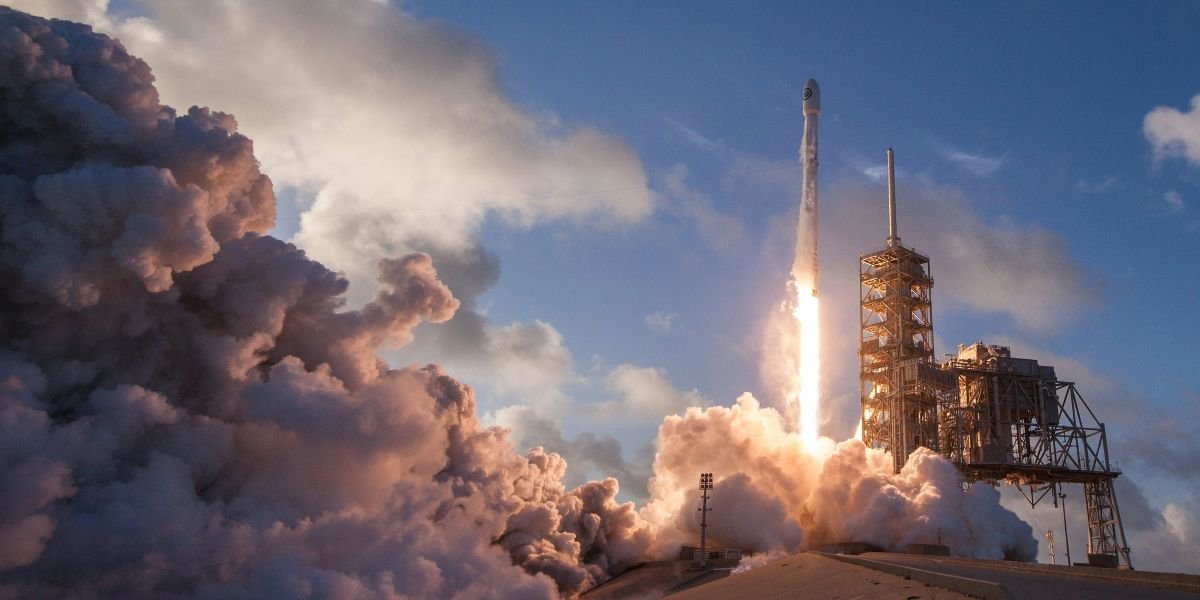

SpaceX marked another milestone in California’s growing role as a global commercial launch hub early Monday morning, when a Falcon 9 rocket lifted off from Vandenberg Space Force Base on the Central Coast and successfully delivered 119 payloads to sun-synchronous orbit as part of the Transporter-16 rideshare mission — the 21st flight in the company’s dedicated smallsat program.
Liftoff of the Transporter-16 mission from Space Launch Complex 4 East occurred at 4:02 a.m. PDT, with the Falcon 9 ascending on a southern trajectory out of Vandenberg before deploying its payload stack to low Earth orbit. The mission executed without incident, cementing what has become a reliable quarterly cadence for commercial satellite operators seeking affordable access to space from California’s West Coast range.
A Mission Built for the Global Small Satellite Market
Transporter-16’s payloads included picosatellites, nanosatellites, and an orbital service vehicle, with German-based Exolaunch serving as the largest customer, manifesting 57 payloads on the mission. The scope of the manifest underscores the increasingly international character of California-launched commercial space ventures.
Payloads originated from 13 countries, including Canada, France, Malaysia, Nepal, Norway, Romania, Scotland, Spain, Switzerland, Taiwan, the United Kingdom, the United States, and Vietnam.
The cargo included cubesats, microsats, hosted payloads, a reentry vehicle, and orbital transfer vehicles carrying eight of those payloads to be deployed at a later time. Among the more notable payloads aboard the mission was the Gravitas satellite from K2 Space — a spacecraft with a 40-meter wingspan when its solar panels are unfurled, weighing approximately two metric tons and designed to produce 20 kilowatts of electricity, intended to test technologies needed for power-hungry in-orbit data centers.
Varda Space also flew its sixth reentry satellite bus, designed for on-orbit manufacturing.
Reusability Drives the Commercial Launch Economy
The Transporter-16 mission also demonstrated the degree to which booster reusability has become foundational to SpaceX’s commercial launch economics — and by extension, to the cost structure available to satellite operators worldwide.
The Falcon 9 first stage booster for this mission, B1093, made its 12th flight, having previously supported a pair of Space Development Agency missions and nine batches of Starlink satellites. More than 8.5 minutes after liftoff, B1093 landed on the drone ship “Of Course I Still Love You,” positioned in the Pacific Ocean — marking the 187th landing on that vessel and the 592nd booster landing for SpaceX to date.
A booster executing its 12th flight would have been considered an engineering achievement just a few years ago. Today, it is an operational routine that directly enables competitive rideshare pricing. Payload deployments began at T+55 minutes and concluded at T+2 hours and 31 minutes after liftoff.
Across its Transporter and Bandwagon rideshare programs combined, SpaceX has now lofted more than 1,600 payloads to orbit, with Transporter-1 in January 2021 still holding the single-launch record at 143 payloads.
Vandenberg’s Role in California’s Space Economy
The Transporter-16 launch arrives as Vandenberg Space Force Base continues to consolidate its position as a critical node in California’s aerospace industrial corridor. Vandenberg is currently home to the world’s second-busiest spaceport, with the Central Coast emerging as a hub of space launch operations backed by a growing ecosystem of commercial partners.
That position has been reinforced by deliberate state investment. A $9.5 million state investment is fueling the Space Vandenberg initiative — a public-private effort to transform the base into the nation’s premier spaceport and innovation hub, with goals of creating thousands of jobs and attracting billions in investment to the Central Coast region.
2025 saw Vandenberg Space Force Base complete a record 77 space launch, missile test, and aeronautical operations in a single year — a figure that reflects both the acceleration of SpaceX’s Starlink deployment cadence and growing demand from third-party commercial operators using Transporter-series rideshare slots.
The operational geography of the California range is also strategically important. Sun-synchronous orbit — the destination of choice for Earth observation, climate monitoring, and remote sensing missions — requires a high-inclination polar trajectory that is operationally well-suited to launches from Vandenberg rather than from Florida’s Kennedy Space Center, which is optimized for lower-inclination eastward launches. That geographic advantage positions California as a structurally necessary launch point for the imaging and environmental satellite sectors.
Contested Terrain: Starship and the Coastal Commission
Despite Monday’s successful mission, SpaceX’s broader expansion plans at Vandenberg remain the subject of active dispute between the company, federal authorities, and California’s environmental regulatory structure.
Space Launch Delta 30 issued a Request for Information in late December 2025 to gauge interest from commercial launch providers in leasing and developing Space Launch Complex-14 at Vandenberg — seeking to establish infrastructure for heavy and super-heavy vertical launch vehicles to address gaps in launch capabilities at the base. SpaceX is widely considered the most likely candidate for that contract, which would bring Starship operations to California’s Central Coast for the first time.
The U.S. Department of the Air Force approved SpaceX’s expansion to 100 launches per year at Vandenberg in October 2025, overriding two separate votes by the California Coastal Commission, including a unanimous 9-0 rejection. Environmental groups have raised concerns about incomplete biological monitoring data, inadequate sonic boom modeling, and the absence of mitigation tracking — objections that were documented in the Coastal Commission’s formal rejection but ultimately overridden through a federal consistency determination.
The tension between the federal government’s commercial space acceleration agenda and California’s environmental oversight framework is likely to intensify if and when Starship infrastructure moves forward at Vandenberg, given the vehicle’s considerably larger sonic footprint relative to the Falcon 9.
A Statewide Economic Calculation
For California policymakers and regional economic planners, the Transporter-16 mission reflects both the state’s aerospace momentum and the scale of decisions now shaping it. Launch companies and aerospace manufacturers are hiring hundreds of Central Coast residents, with the sector identified as a priority growth area under California’s Uplift Central Coast and California Jobs First economic development strategies.
The Space Vandenberg initiative is expected to drive job creation, fuel entrepreneurship, and unlock new investment across the region, with Cal Poly San Luis Obispo committed to supplying aerospace talent and supporting California’s continued leadership in space.
As Monday’s pre-dawn launch lit up the skies above Santa Barbara County, it served as a visible reminder that California’s position in the commercial space economy is no longer a projection — it is an operational reality delivering payloads for customers in more than a dozen countries, from a launchpad on the California coast.