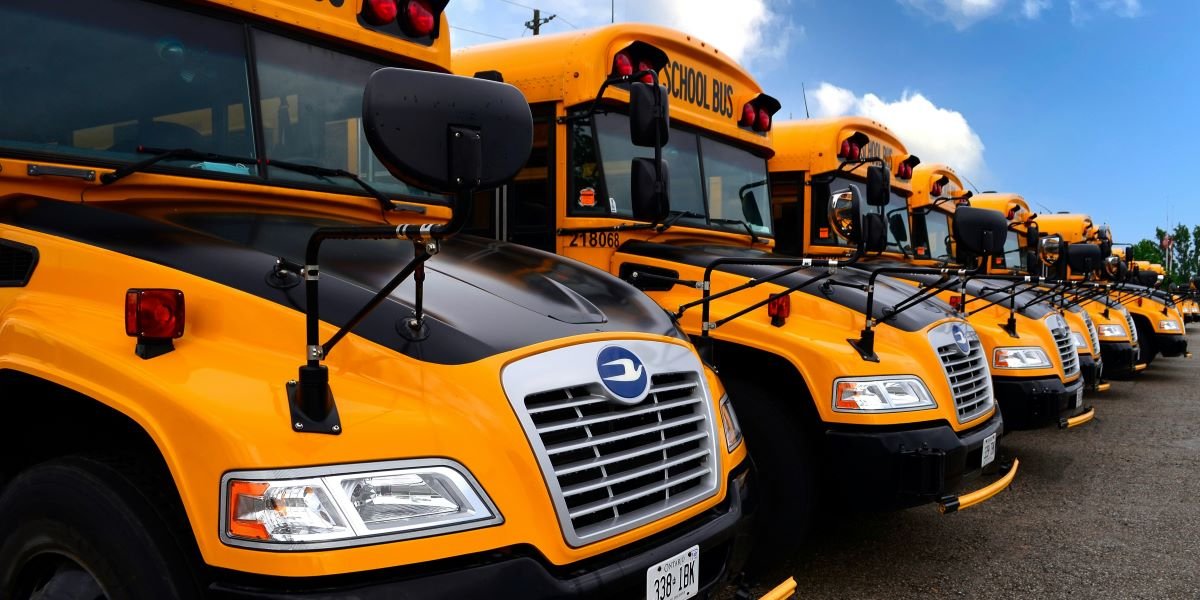

California opened a second round of electric school bus funding on November 17, 2026, offering at least $55 million for vehicle replacements and charging infrastructure. The Zero-Emission School Bus and Infrastructure Incentive Project also supports qualifying workforce training, maintenance equipment, and transportation facility improvements, connecting new bus purchases with the requirements of daily fleet operations.
Key Takeaways
- The second ZESBI solicitation opened November 17 at 10 a.m. Pacific Time, with funding allocated on a first-come, first-served basis.
- Applicants must request at least one charger for every new zero-emission school bus.
- Maximum vehicle incentives range from $320,000 to $400,000, depending on bus type, before eligible wheelchair-lift incentives.
- Up to 10% of qualifying grant awards may support school transportation program expenses.
- Participating educational agencies must replace eligible older school buses, generally with chassis from model year 2010 or earlier.
California’s Second Funding Round Connects Buses With Infrastructure
California’s Zero-Emission School Bus and Infrastructure (ZESBI) Incentive Project is accepting applications for its second solicitation, combining financial support for new school buses with the equipment needed to charge them.
The California Air Resources Board and California Energy Commission jointly support the program, with Catalyst Mobility administering the incentives. At least $55 million in funding remaining from the earlier solicitation was announced for the new application period.
Unlike the previous funding round, applications are reviewed on a first-come, first-served basis without the earlier priority-tier system. The change makes submission timing and complete documentation relevant to the allocation process.
Eligible applicants include qualifying California public school districts, county offices of education, joint powers authorities, and public charter schools serving kindergarten through grade 12. Participation depends on the program’s institutional and vehicle requirements.
The program is designed to support the replacement of older internal-combustion school buses with zero-emission vehicles while addressing the supporting infrastructure required for transportation departments.
Charging Infrastructure Is Required With Every New Bus
California’s second ZESBI solicitation requires participating educational agencies to request at least one charger for each new zero-emission school bus. Applications seeking only vehicles or only charging infrastructure are not permitted.
This requirement connects vehicle acquisition with charging preparation from the beginning of the funding process. Districts must consider equipment selection, electrical connections, transportation-yard conditions, and the steps needed before chargers can enter service.
Published incentives provide up to $20,000 for an eligible Level 2 charger and up to $75,000 for a qualifying direct-current fast charger. A higher ceiling of $95,000 applies to the first eligible bidirectional fast charger.
These amounts represent maximum incentives rather than guaranteed funding for every installation.
California has separately funded electric vehicle charging infrastructure across the state, reflecting the broader role of charging access in transportation electrification. Those programs remain separate from the school bus incentives.
School Transportation Departments Can Receive Training Support
California’s ZESBI program also recognizes that operating electric school buses involves changes to transportation department equipment and staff preparation.
Up to 10% of a qualifying grant award may support eligible School Transportation Program expenses. The allowance can cover activities such as zero-emission workforce training, technical assistance, certain repairs, maintenance equipment, and transportation-yard improvements.
These expenses address practical responsibilities beyond purchasing vehicles. Transportation technicians may need instruction on electric drivetrains, charging equipment, diagnostic systems, and high-voltage safety procedures.
Transportation departments may also require equipment suited to maintaining electric buses and supporting their charging systems. However, eligible expenses remain subject to program rules and grant approval.
The emphasis on technical preparation is consistent with California’s statewide zero-emission vehicle strategy, which identifies workforce development alongside vehicles and infrastructure as part of the transition.
No training completion figures or employment outcomes have been established for the newly opened solicitation.
Replacing Older School Buses Involves Additional Requirements
California’s ZESBI funding is structured around replacing qualifying older school buses rather than expanding fleets without corresponding vehicle retirement.
Each funded replacement requires an eligible older bus to be retired and scrapped. The replaced vehicle generally must have a chassis model year of 2010 or earlier, a gross vehicle weight rating exceeding 10,000 pounds, and the required ownership and safety documentation.
Maximum vehicle incentives vary by bus configuration. Type A buses qualify for up to $320,000, Type C buses for up to $380,000, and Type D buses for up to $400,000, including the additional $40,000 incentive. Eligible wheelchair-lift equipment may increase these ceilings by $15,000.
The published amounts do not guarantee complete purchase-cost coverage. Actual awards depend on eligibility, equipment specifications, documentation, and available funding.
Applicants must also complete multiple administrative stages before funding becomes binding, including required agreements and vehicle purchase documentation.
School Bus Funding Fits Within California’s Fleet Transition
California’s electric school bus incentives form one part of the state’s wider efforts to introduce zero-emission vehicles into transportation fleets.
Other initiatives, including California’s separate commercial electric truck incentive program, address different vehicle categories and operating requirements.
The school bus program concentrates on local educational agencies and the infrastructure supporting student transportation. Its stated objectives include reducing transportation-related emissions and improving air quality, although outcomes from the second solicitation have not yet been measured.
For school transportation departments, the current funding opportunity involves coordinated planning for vehicles, chargers, maintenance resources, and staff training. Actual deployment results will depend on approved awards and completed projects.
FAQs
How Much Funding Is Available for California Electric School Buses?
California announced at least $55 million in remaining funding for the second ZESBI solicitation. The amount still available after applications began has not been independently confirmed.
When Did California’s Second School Bus Funding Round Open?
Applications opened November 17, 2026, at 10 a.m. Pacific Time. Funding is allocated on a first-come, first-served basis, subject to program requirements.
Do School Districts Need to Request Charging Equipment?
Yes. The second solicitation requires at least one charger request for every new zero-emission school bus. Vehicle-only and infrastructure-only applications are not permitted.
Can Funding Support Maintenance Equipment and Staff Training?
Yes. Up to 10% of a qualifying grant award may support eligible transportation program expenses, including workforce training, technical assistance, repairs, and maintenance equipment.
Does the Program Cover the Full Cost of Electric School Buses?
Not necessarily. The program provides maximum incentive amounts based on eligible bus types and equipment, but final funding depends on approved expenses and program conditions.