California is currently holding back on using a historic “price gouging” law that allows the state to cap oil refinery profits, even as gasoline prices at the pump remain among the highest in the nation. The law, known as Senate Bill X1-2, was signed in 2023 to prevent energy companies from making “excessive” profits during supply shortages, but the California Energy Commission (CEC) has yet to set a specific profit margin limit or issue any penalties. While gas prices in many parts of the state have climbed above $5.30 per gallon due to global oil volatility, state regulators have delayed the full implementation of these penalties for five years, citing the need for more data and the risk of unintended supply shortages.
The Mechanics of the Penalty Law
The landmark legislation was designed to bring transparency to a market that many Californians feel is unfair. Under the law, the CEC created a new division called the Division of Petroleum Market Oversight. This team has the power to look at the confidential books of oil refiners to see exactly how much they are paying for crude oil versus how much they are charging at the pump. If the “refiner margin”—the difference between the cost of crude and the wholesale price of gasoline—is deemed too high, the state can fine the companies.
However, setting that limit has proven difficult. The CEC recently confirmed that it would take a cautious approach, extending the “study period” for five years. This means that while they are watching the data, they are not yet ready to stop a price spike with a legal cap. Currently, the average price of gas in California is $5.34 per gallon, which is $1.85 higher than the national average of $3.49.
Expert Perspectives on the Delay
The decision to wait has created a divide between consumer groups and energy experts. Consumer advocates argue that every day the state waits, residents lose money. Jamie Court, the president of Consumer Watchdog, has been a vocal critic of the slow rollout. He stated that the “California Energy Commission has the tools to stop the gouging right now, but they are choosing to sit on their hands while oil companies report record-breaking margins.” The court argues that without a “hard cap” on profits, the transparency measures are not enough to lower prices for the average driver.
On the other side, energy economists warn that moving too fast could backfire. Severin Borenstein, an energy expert at UC Berkeley’s Haas School of Business, has pointed out that California is an “energy island.” Because the state uses a special blend of cleaner-burning gasoline and is not connected to many pipelines from the rest of the country, it relies heavily on a small number of local refiners. Borenstein has noted that if the state sets a profit cap too low, refiners might simply stop producing gas or export it elsewhere, which would cause an even bigger supply shortage and send prices even higher.
Data: The Cost of the “California Mystery”
State data shows that the gap between California gas prices and the rest of the U.S. has widened significantly over the last decade. In 2014, the gap was usually around $0.40 per gallon. Today, that gap frequently stays above $1.50. While about $0.70 of that difference comes from higher state taxes and environmental fees, the remaining $0.80 is what experts call the “mystery surcharge.”
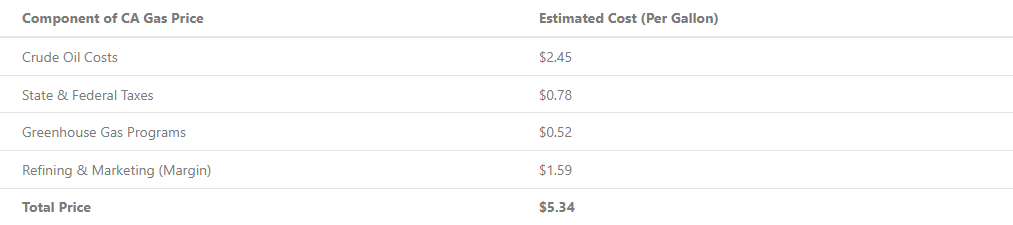
The goal of the unused law is to shrink that “Refining & Marketing” section of the price. The CEC’s data shows that refinery margins in California spiked to over $1.00 per gallon during several weeks in 2023 and 2024, while the historical average is closer to $0.50.
The Industry’s Response
The oil industry maintains that prices are driven by supply and demand, not greed. Representatives from the Western States Petroleum Association (WSPA) argue that California’s own policies are the primary reason for high costs. Catherine Reheis-Boyd, the CEO of WSPA, has stated that “additional mandates and the threat of penalties only make it harder to do business in California.” The industry argues that instead of capping profits, the state should focus on making it easier to maintain and upgrade the existing refineries to prevent the frequent “unplanned maintenance” that often leads to price spikes.
The Road Ahead for 2026
For now, the law serves more as a “threat” than a functional tool. The CEC is currently in the middle of a series of public workshops to determine what a “fair” profit looks like. They are collecting millions of data points every day from the state’s 11 major refineries.
Governor Gavin Newsom has remained supportive of the commission’s careful pace, even as he publicly attacks “Big Oil.” His administration believes that by collecting the data first, the state will be on stronger legal ground when they eventually do decide to pull the trigger on penalties. Until then, Californians will continue to pay a premium at the pump, hoping that the “transparency” alone is enough to keep oil companies from pushing prices even higher during the upcoming summer driving season.
The five-year delay means that a final decision on a specific “profit cap” might not come until 2028 or later. For the millions of Californians who spend over $3,000 a year on gasoline, the law remains a promise that has yet to be kept.